

What Are Cataracts?
Cataracts are a common age-related condition where the eye's natural lens becomes cloudy, causing blurry, dim, or faded vision. This isn't a film growing over the eye-it's a change inside the lens itself. Over time, proteins in the lens clump together, scattering light instead of focusing it clearly on the retina. The result? Colors look washed out, glare from headlights or sunlight becomes blinding, and reading small print feels impossible-even with glasses.
By age 80, more than half of all Americans either have cataracts or have had surgery to remove them. It’s not rare. It’s normal aging. But unlike wrinkles or gray hair, cataracts directly affect your ability to see the world clearly. Left untreated, they can lead to significant vision loss. The good news? Cataracts don’t have to be permanent.
How Cataracts Develop Over Time
The lens of your eye is made mostly of water and protein. As you age, these proteins start to break down and stick together. This process is slow. You might not notice it at first. Early signs include needing brighter light to read, seeing halos around lights, or colors seeming less vivid. Many people think they just need new glasses. But if your prescription keeps changing without improvement, it’s likely cataracts.
Age is the biggest factor, but others play a role too. Long-term exposure to UV sunlight, smoking, heavy alcohol use, diabetes, and certain medications like steroids can speed up the process. Some people develop cataracts earlier due to eye injuries or inherited conditions. But for most, it’s simply time. The lens, like any part of the body, wears out.
How Cataract Surgery Works Today
Modern cataract surgery is one of the safest and most effective procedures in all of medicine. Over 3.8 million Americans have it every year. It’s done as an outpatient procedure-no hospital stay. You’re awake, but your eye is numbed with drops. Most people feel only slight pressure, nothing painful.
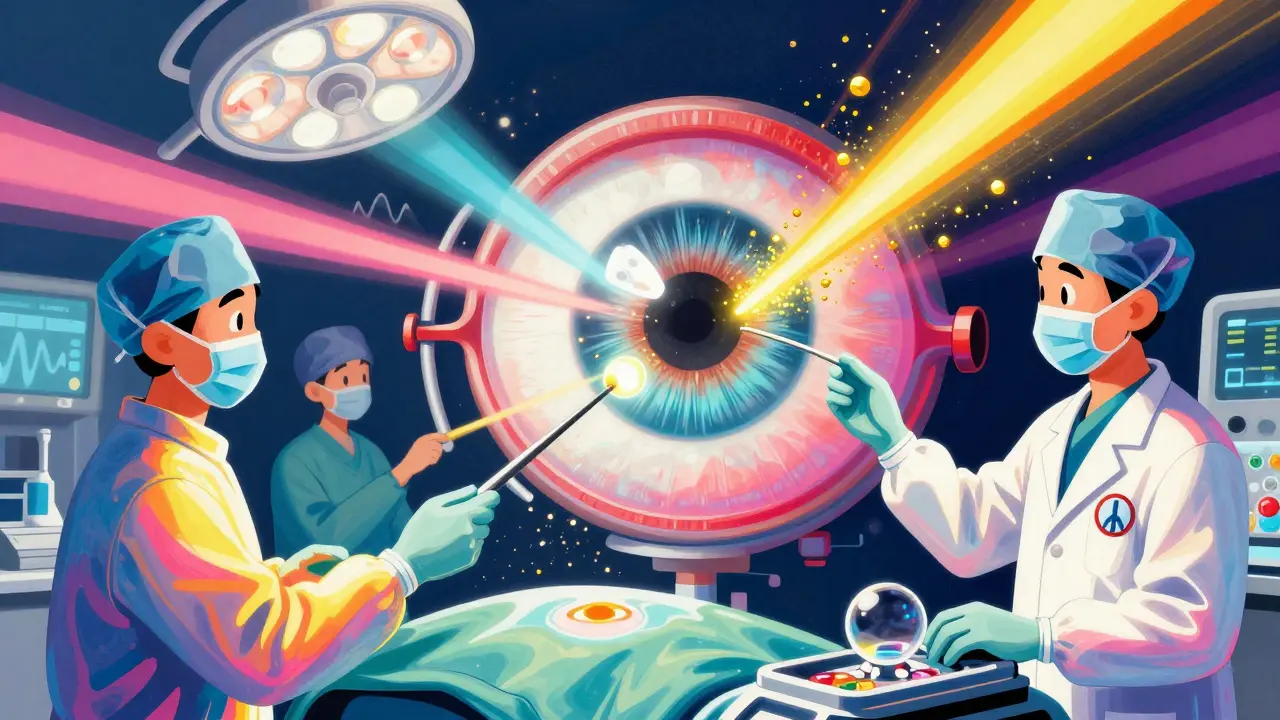
The most common technique is called phacoemulsification. A tiny ultrasound probe is inserted through a 2.2- to 2.8-millimeter incision in the cornea. It breaks up the cloudy lens into small pieces and gently suctions them out. Then, a new artificial lens-the intraocular lens (IOL)-is folded and slipped into the same spot where your natural lens used to be. Once inside, it unfolds and stays put.
This isn’t like replacing a broken camera lens. The IOL becomes part of your eye. It doesn’t need cleaning or maintenance. And because it’s made of biocompatible materials, your body accepts it without issue.
Types of Intraocular Lenses (IOLs)
Not all IOLs are the same. Your choice affects how much you’ll rely on glasses after surgery.
- Monofocal IOLs correct vision at one distance-usually far. You’ll see clearly at a distance, but you’ll likely still need reading glasses for close-up tasks like checking your phone or reading menus. These are the most common and are covered by Medicare and most insurance plans. Out-of-pocket cost: $1,500-$3,000 per eye.
- Toric IOLs correct astigmatism in addition to cataracts. If you’ve worn glasses for astigmatism your whole life, this lens can reduce or eliminate that need. Cost: $2,000-$4,000 per eye.
- Multifocal and trifocal IOLs like Alcon’s PanOptix or Johnson & Johnson’s Tecnis Symfony let you see clearly at multiple distances-near, intermediate, and far. Studies show 80-89% of patients with these lenses don’t need glasses for daily tasks. But they’re more expensive ($2,500-$4,500 per eye) and not covered by standard insurance. Some people report glare or halos at night, especially in low light.
- Accommodating IOLs are still in trials. These lenses are designed to move slightly inside the eye, mimicking how a young, healthy lens focuses. They’re not yet widely available, but could be the next big step.
Your surgeon will help you pick based on your lifestyle. Do you read a lot? Drive at night? Work on a computer? Your daily habits matter more than your age.
Recovery After Surgery
Most people notice better vision within 1 to 3 days. Colors look brighter. Contrast is sharper. But full healing takes time.
For the first week, you’ll use eye drops: antibiotics to prevent infection and steroids to reduce swelling. You’ll need to avoid rubbing your eye, bending over, lifting anything heavier than 10 pounds, and getting water in your eye-no swimming, showering with eyes open, or washing your hair backward.
It’s normal to feel scratchiness, itchiness, or mild discomfort for a few days. Your vision might be blurry or wavy at first. That’s your brain adjusting to the new lens. Some people say it feels like they’re seeing in HD for the first time. Others say their depth perception feels off. One Reddit user wrote, “My brain had to relearn how far things were.” That’s common.
Full recovery typically takes 4 to 8 weeks. Most clinics recommend waiting at least a week before driving. Your doctor will give you the green light once your vision stabilizes and your eye heals.
What Can Go Wrong?
Cataract surgery has a 99.5% safety rate. But no surgery is perfect.
The most common issue is posterior capsule opacification (PCO). This happens when the thin membrane holding the new lens becomes cloudy. It affects 20-30% of patients within five years. It’s not a cataract coming back-it’s scar tissue. The fix? A quick, painless laser procedure called YAG capsulotomy. It takes five minutes, no incision, and vision clears within hours.
Other rare complications include infection (less than 0.1%), retinal detachment, or swelling in the cornea. These happen in about 2-5% of cases. People with diabetes or glaucoma have a higher risk of slower healing or less complete vision recovery. That’s why your surgeon will review your full medical history before surgery.
Can You Avoid Cataracts?
You can’t stop aging. But you can slow down lens damage.
- Wear UV-blocking sunglasses daily. Even on cloudy days.
- Don’t smoke. Smoking doubles your risk.
- Control blood sugar if you have diabetes.
- Eat leafy greens, colorful vegetables, and omega-3-rich fish. Antioxidants help protect the lens.
- Get regular eye exams after 40. Early detection means better planning.
There’s no pill or eye drop that cures cataracts. Surgery is the only proven fix.

When to Consider Surgery
You don’t need to wait until you’re legally blind. The decision isn’t about how bad your vision is-it’s about how much it’s affecting your life.
Ask yourself:
- Do you struggle to drive at night because of glare?
- Can you read your grandchild’s birthday card without squinting?
- Do you avoid hobbies like painting, sewing, or golf because your vision isn’t sharp enough?
- Have you fallen more often because you can’t see steps or curbs clearly?
If the answer is yes to any of these, it’s time to talk to an ophthalmologist. Delaying surgery doesn’t make it harder to remove the cataract-it just makes life harder.
Visual Rehabilitation After Surgery
Some people need more than just a new lens. Your brain needs time to adapt. That’s where vision therapy comes in.
Simple exercises-like shifting focus between a book and a wall across the room-help your eyes and brain relearn how to work together. Studies show this reduces eye strain, improves focus, and even boosts memory and concentration after surgery. It’s not magic. It’s training. And it’s especially helpful if you chose a multifocal IOL or had a long-standing cataract.
Many clinics now offer these exercises as part of post-op care. Ask your doctor if it’s right for you.
The Future of Cataract Treatment
The technology keeps improving. New IOLs are being designed for better intermediate vision-perfect for computer screens and tablets. Zeiss’s AT LISA tri 839MP, approved in early 2023, is already helping patients see clearly at arm’s length without glasses.
Researchers are also working on lenses that can adjust focus automatically, like a young, healthy lens. These accommodating IOLs are in late-stage trials. If successful, they could be available within the next few years.
Meanwhile, the global market for cataract devices is growing fast-projected to hit $6.32 billion by 2027. That’s because the population is aging. And people want to keep seeing clearly.
Final Thoughts
Cataracts are not a disease. They’re a natural part of getting older. But they don’t have to mean losing your independence. With modern surgery, you can regain sharp, clear vision-and often, a new appreciation for the world around you.
It’s not just about seeing better. It’s about seeing again. The vibrant colors, the faces of loved ones, the stars at night. Those moments aren’t lost. They’re just waiting for you to take the next step.
Can cataracts come back after surgery?
No, cataracts cannot return because the natural lens is removed. But the thin membrane holding the new lens can become cloudy over time. This is called posterior capsule opacification (PCO), and it’s easily fixed with a quick laser procedure that takes less than five minutes.
Will I still need glasses after cataract surgery?
It depends on the type of intraocular lens (IOL) you choose. Monofocal IOLs correct distance vision, so you’ll likely need reading glasses. Toric IOLs correct astigmatism and may reduce your need for glasses. Multifocal or trifocal IOLs are designed to minimize or eliminate glasses use for most daily activities. About 80-90% of patients with premium lenses don’t need glasses for routine tasks.
How long does cataract surgery take?
The actual surgery lasts about 15 to 20 minutes per eye. You’ll be at the surgical center for about 2 to 3 hours total, including check-in, prep, and recovery time before you go home. Most people resume normal activities within a day or two, but full healing takes 4 to 8 weeks.
Is cataract surgery covered by insurance?
Standard monofocal IOLs and the basic surgical procedure are covered by Medicare and most private insurance plans. Premium lenses-like toric, multifocal, or trifocal IOLs-are considered elective upgrades. These are not covered and require out-of-pocket payment, typically $2,500 to $4,500 per eye.
What’s the success rate of cataract surgery?
Cataract surgery has a success rate of over 95%. About 98% of patients report high satisfaction with their results. Vision improves significantly in nearly all cases, with most people achieving 20/40 vision or better. Complications are rare, occurring in only 2-5% of cases, and most are treatable.
Can I have surgery on both eyes at once?
No. Surgery is done on one eye at a time, usually a few weeks apart. This allows the first eye to heal and your vision to stabilize before operating on the second. It also reduces risk and gives your surgeon a chance to fine-tune the lens choice for the second eye based on how the first one healed.
How do I know if I’m a good candidate for premium IOLs?
If you want to reduce or eliminate your dependence on glasses, especially for reading or computer use, premium IOLs may be right for you. Your surgeon will evaluate your eye health, lifestyle, and expectations. If you have other eye conditions like macular degeneration or glaucoma, premium lenses may not be recommended. A thorough consultation is essential.
Mussin Machhour
December 24, 2025 AT 19:30Sophie Stallkind
December 25, 2025 AT 03:09Katherine Blumhardt
December 26, 2025 AT 01:12sagar patel
December 26, 2025 AT 12:47Bailey Adkison
December 27, 2025 AT 13:19Oluwatosin Ayodele
December 28, 2025 AT 10:24Rick Kimberly
December 29, 2025 AT 01:28Terry Free
December 30, 2025 AT 00:22