
When a pill leaves the factory, it doesn’t stop being monitored. In fact, the real test of its quality begins only after it’s packaged and shipped. Stability testing is the quiet, behind-the-scenes process that ensures every medication remains safe, effective, and unchanged from the day it’s made until the day a patient takes it-even years later. This isn’t optional. It’s the legal and scientific backbone of every drug on the shelf.
Why Stability Testing Isn’t Just Bureaucracy
People often think quality control ends when a batch passes inspection and gets labeled. But drugs aren’t static. Heat, moisture, light, and time can break them down. A painkiller might lose potency. An antibiotic could turn toxic. A biologic therapy might clump together and stop working. Without stability testing, these changes go unnoticed until someone gets sick-or worse. The system was built to prevent that. Back in 1990, regulators from the U.S., Europe, and Japan came together to create the International Council for Harmonisation (ICH). Their goal? One set of rules that every drug maker, everywhere, had to follow. Today, ICH Q1A(R2) is the bible for stability testing. It’s not a suggestion. It’s a requirement for approval. If you can’t prove your drug won’t degrade, you can’t sell it. In 2021, nearly 1 in 6 drug recalls in the U.S. traced back to stability failures. Not contamination. Not mislabeling. Degradation. That’s why every new drug application includes stability data covering months-or years-of real-world conditions.How It Actually Works
Picture a room, locked and silent, filled with shelves of drug bottles. No one goes in. No one touches them. Just sensors. Constantly. These are stability chambers. And they’re set to exact conditions: 25°C and 60% humidity for most products. For hotter climates, it’s 30°C and 65% humidity. Some are pushed harder: 40°C and 75% humidity to simulate years of aging in just six months. At 0, 3, 6, 12, 24, and 36 months, samples are pulled. Not just checked. Analyzed. Scientists run tests to see:- How much active ingredient is left (assay)
- What new chemicals have formed (degradation products)
- Whether the tablet still dissolves properly (dissolution)
- If the color changed, the capsule cracked, or the liquid turned cloudy
- Whether bacteria or mold grew (especially for injectables)
The Data That Decides Expiration Dates
Expiration dates aren’t guesses. They’re math. ICH Q1E gives the formula: you need to be 95% confident that 95% of all units will stay within specs until that date. That’s not easy. You can’t just average results. You need statistical models, trend lines, confidence intervals. A drug might look fine at 18 months. But if the degradation curve is steep, the expiration date might be set at 24 months-not 36-even if no samples failed yet. Why? Because the next batch could degrade faster. The system is built to be conservative. Safer for patients. Real-time testing takes years. Accelerated testing gives early warnings. But only real-time data can be used for official labeling. That’s why new drugs often hit the market with expiration dates based on 12-24 months of data, with the full 36-month study still running. If the trend holds, the date gets extended later.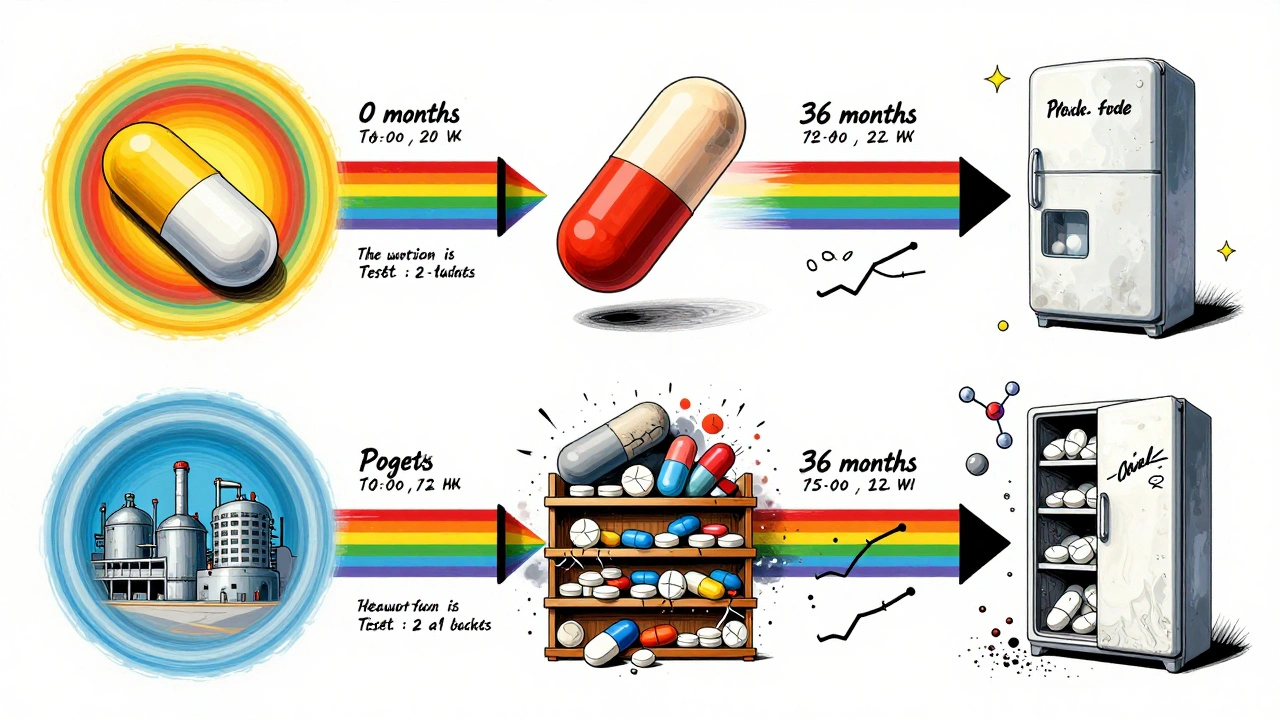
What Happens When It Fails
An out-of-specification (OOS) result is a red alarm. It doesn’t mean the whole batch is bad. But it means something went wrong. Was it the environment? A bad batch of raw material? A faulty container? The quality team has 72 hours to start an investigation. Every step is documented. Every hypothesis tested. Every conclusion reviewed by legal and regulatory teams. In 2021, the FDA issued a warning letter to a company that ignored OOS results for a cancer drug. Approval was delayed 14 months. The cost? Millions in lost sales and reputational damage. But failure can also be a win. In 2022, a biologic drug’s stability test revealed a chemical reaction between the drug and its glass vial. The manufacturer switched to a new container before launch-avoiding a $500 million recall. That’s stability testing doing its job: catching problems before patients ever see them.Who Does It and How Much It Costs
Big pharma runs their own stability labs. SGS, Eurofins, and Charles River Laboratories run them for everyone else. About 72% of companies outsource at least part of their testing. Why? It’s expensive. A single qualified stability chamber costs over $100,000. Quarterly temperature mapping? $8,500 per unit. Validating a new analytical method? 3-6 months and $50,000+. Small biotechs can’t afford that. So they partner with CROs. But even then, a full stability program for a single product can run $150,000-$500,000 a year. And that’s just the testing. Add in the people: chemists, data analysts, QA specialists, regulatory writers. A single product might need 5-8 dedicated staff. The good news? New approaches are cutting costs. ICH Q12 lets companies use data from development to support post-approval changes. One generics maker cut sample sizes by 40% and saved $120,000 per product annually. Quality by Design (QbD) cuts testing needs by 25-35% for well-understood drugs.
The Future: AI, Real-Time, and Risk-Based Testing
The field is changing. In February 2023, ICH finalized Q13, a new guideline for continuous manufacturing-where drugs are made in a constant flow, not in batches. That means stability testing can’t wait until the end. Sensors now monitor temperature, humidity, and even chemical changes in real time during production. AI is coming fast. By 2027, machine learning models could predict degradation pathways with 80% accuracy, cutting testing time by 30-40%. Instead of waiting 36 months, companies might get reliable predictions in 6. But regulators won’t abandon real-time data. Not yet. The safest drugs are still the ones proven by time. The shift is toward smarter testing: more data, less waiting, fewer samples for proven products, more for complex ones like gene therapies or personalized medicines.What This Means for Patients
You don’t see stability testing. But you benefit from it every time you take a pill. It’s why your insulin still works after six months in the fridge. Why your blood pressure med doesn’t turn into something dangerous. Why your child’s antibiotic hasn’t lost its punch. It’s also why recalls happen. And why they’re rare. Stability testing is the last line of defense. It’s slow. It’s expensive. It’s tedious. But it’s the only thing that turns a chemical compound into a medicine you can trust.What’s Next for Stability Testing
The FDA’s 2023 draft guidance on continuous manufacturing is just the start. More drugs will be monitored in real time. More biologics will need testing as they become mainstream. Emerging markets are catching up, too. WHO is pushing for global alignment on stability standards. The goal isn’t to make testing faster. It’s to make it smarter. To focus resources where they matter most. To protect patients without wasting time on low-risk products. Stability testing isn’t about checking boxes. It’s about keeping people alive.What is the main purpose of stability testing in pharmaceuticals?
The main purpose is to determine how a drug’s quality changes over time under real-world conditions like heat, humidity, and light. This data is used to set safe expiration dates, define proper storage instructions, and ensure the medicine remains effective and safe for patients until the date printed on the package.
How long does stability testing typically take?
For new drugs, real-time stability testing usually runs for 24 to 36 months under standard conditions (25°C/60% RH). Accelerated testing at 40°C/75% RH is done for 6 months to predict long-term behavior, but only the real-time data can be used for official expiration dates.
What happens if a stability test shows a drug has degraded?
An out-of-specification (OOS) result triggers a formal investigation. The manufacturer must determine the root cause-was it a manufacturing error, packaging flaw, or storage issue? If the problem affects safety or efficacy, the batch may be rejected, the product recalled, or regulatory approval delayed. In severe cases, the entire product line can be pulled from the market.
Is stability testing required for all drugs?
Yes. Since 2010, every FDA-approved new drug has been required to submit full stability data. This includes small-molecule pills, biologics, injectables, and even over-the-counter products. The only exceptions are some compounded or investigational drugs under strict controls.
Can stability testing be shortened with new technology?
Yes, but not fully replaced. AI and predictive modeling can now estimate degradation trends with high accuracy, potentially reducing testing time by 30-40%. However, regulatory agencies still require real-time data for final expiration dates. New tools help prioritize testing and reduce sample sizes, but they don’t eliminate the need for long-term monitoring.
Why do some companies outsource stability testing?
Stability testing requires expensive infrastructure-precision chambers, validated analytical labs, trained staff, and strict compliance systems. Smaller companies, especially biotechs, often lack the budget or expertise to run these labs in-house. Outsourcing to CROs like SGS or Eurofins is more cost-effective and ensures compliance with global standards.
How does stability testing impact drug pricing?
Stability testing adds significant cost to drug development-up to $2 million per company annually. These costs are factored into pricing, especially for complex drugs like biologics. However, it also prevents costly recalls and delays, which can be far more expensive. In the long run, it protects both patients and manufacturers.
What are the most common failures in stability testing?
The most common failures are loss of potency (active ingredient degrading), formation of unsafe degradation products, changes in dissolution rate (tablet won’t break down properly), and physical changes like discoloration or clumping. Container-closure interactions-where the drug reacts with its bottle or cap-are also a growing concern, especially for biologics.
Fern Marder
December 2, 2025 AT 07:00Sandi Allen
December 4, 2025 AT 00:52John Webber
December 5, 2025 AT 02:37Victoria Graci
December 5, 2025 AT 22:04Saravanan Sathyanandha
December 6, 2025 AT 17:54alaa ismail
December 6, 2025 AT 17:54ruiqing Jane
December 7, 2025 AT 11:52Carolyn Woodard
December 7, 2025 AT 19:18Allan maniero
December 9, 2025 AT 17:37Anthony Breakspear
December 10, 2025 AT 13:11Zoe Bray
December 11, 2025 AT 04:04Girish Padia
December 11, 2025 AT 09:12Saket Modi
December 13, 2025 AT 01:46Chris Wallace
December 13, 2025 AT 05:13william tao
December 14, 2025 AT 14:13