

One in five children in the U.S. has obesity. That’s not a distant statistic-it’s your neighbor’s kid, your child’s classmate, maybe even your own child. And it’s not just about looks or discipline. Childhood obesity is a medical condition tied to higher risks of type 2 diabetes, heart disease, and mental health struggles later in life. The good news? It’s preventable. And when it does happen, the most effective treatment isn’t a diet plan or a pill-it’s the whole family working together.
What Exactly Is Childhood Obesity?
Childhood obesity isn’t just being "a little chubby." It’s defined by a child’s body mass index (BMI) at or above the 95th percentile for their age and sex, using CDC growth charts. That means they weigh more than 95 out of 100 kids their age. Since the 1970s, rates have tripled. Today, about 19.7% of U.S. children and teens are affected. This isn’t a phase. It’s a chronic condition that often tracks into adulthood.
And it’s not caused by laziness or bad parenting. It’s a mix of environment, habits, genetics, and access to healthy food. A child growing up in a home where sugary drinks are the default beverage, screen time replaces outdoor play, and meals are rushed or eaten in front of the TV is at higher risk-even if they’re not eating "junk food" all the time.
Why Family-Based Treatment Is the Gold Standard
For decades, doctors tried treating childhood obesity by focusing only on the child. Give them a diet. Tell them to exercise more. But it rarely worked long-term. Kids don’t live in isolation. They eat what’s in the fridge, watch what their parents watch, and copy how their caregivers move through the day.
Family-based behavioral treatment (FBT) flips that. It treats the family as the system that needs to change-not just the child. Developed in the 1980s by Dr. Leonard Epstein and refined over 40 years of research, FBT is now the #1 recommended approach by the American Academy of Pediatrics, the American Psychological Association, and the National Institutes of Health.
Here’s what makes it different: FBT doesn’t just tell parents what to do. It teaches them how to create lasting change at home. And it works. In a major 2023 trial published in JAMA Network Open, children in FBT lost 12.3% more of their excess weight than those in usual care. Parents lost weight too. And even siblings who weren’t in the program showed better weight outcomes-just by being part of the changed household.
The Core Pieces of Family-Based Treatment
FBT isn’t a one-size-fits-all program. But all effective versions include these five key elements:
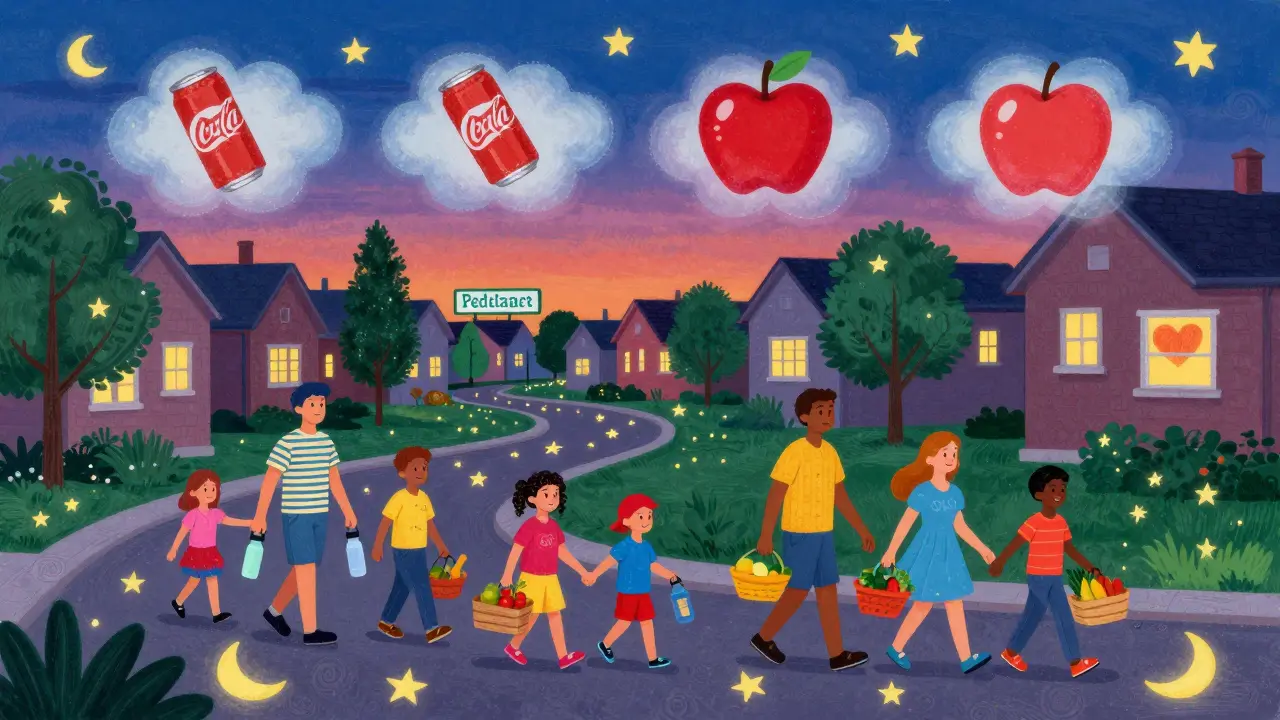
- The Stoplight Diet-This isn’t about cutting out foods. It’s about categorizing them: Green foods (fruits, veggies, whole grains) can be eaten freely. Yellow foods (dairy, lean meats, whole-grain pasta) should be eaten in moderation. Red foods (sugary snacks, fried foods, soda) are for special occasions. Studies show this approach leads to a 9.38% drop in percentage overweight within six months.
- 60 minutes of daily movement-It doesn’t have to be sports. Walking the dog, dancing in the kitchen, playing tag after dinner-it all counts. The goal is to get kids moving regularly, not just at gym class.
- Behavior tracking-Families keep simple logs: what they ate, how long they were active, how much screen time they had. This isn’t about guilt. It’s about awareness. You can’t fix what you don’t measure.
- Parenting skills-Parents learn how to set limits without yelling, use praise instead of punishment, and avoid using food as a reward or comfort. A child who learns that cookies = love will struggle with emotional eating for life.
- Family routines-Eating meals together, turning off screens an hour before bed, having consistent bedtimes. These habits reduce obesity risk by up to 12%. They’re not optional extras. They’re the foundation.
How Long Does It Take? What Does It Look Like?
Most programs run 6 to 24 months, with 16 to 32 sessions total. The 2023 JAMA trial used 26 sessions over two years, delivered by trained health coaches in pediatric clinics. Families didn’t need to go to a specialty center-they got support right where they already went: the pediatrician’s office.
On average, families completed about 20 sessions-not all 26. That’s okay. Progress isn’t linear. Some weeks are great. Others, life gets in the way. The goal isn’t perfection. It’s consistency.
Session frequency varies. Some families meet weekly at first, then every other week. Others start with monthly check-ins. The key is that a trained coach is there to help them problem-solve: "My kid won’t touch vegetables." "We don’t have time to cook." "The other kids at school eat chips every day."
And here’s the kicker: FBT doesn’t just help the child. Parents lose weight too. In the same study, parents lost 5.7% more body weight than those in control groups. That’s because they’re changing their own habits-eating more vegetables, walking more, cutting back on soda. When parents model healthy behavior, kids follow.
What About Cost and Access?
FBT costs about $3,200 per family over two years. That’s less than specialty clinics, which average $4,100. And it’s cost-effective-$18,400 per quality-adjusted life year gained, well under the $50,000 benchmark health economists use.
Medicare and Medicaid cover intensive behavioral therapy for obesity (code G0447). But only 5% of eligible kids get it. Why? Because most pediatricians don’t have the staff or training to deliver it. That’s changing. New models pair pediatricians with behavioral health coaches. In the 2023 trial, 87% of families completed at least 12 sessions-compared to just 63% in specialty clinics.
Barriers still exist. Families without cars, with multiple jobs, or who speak limited English often can’t access these services. Hispanic and Black children make up more than half of childhood obesity cases but only 31% of FBT participants. Language, culture, and trust matter. Programs that hire bilingual coaches or meet families in community centers see much better results.

When FBT Isn’t Enough
FBT works best for most children. But for those with severe obesity-BMI at or above 120% of the 95th percentile-it’s not always enough. In these cases, fewer than half of kids lose even 5% of their weight with FBT alone.
That’s when doctors consider other options: medications like semaglutide (Wegovy) for teens, or metabolic surgery for older adolescents with serious health complications. These aren’t "last resorts." They’re tools. And they work best when combined with FBT, not instead of it.
Experts warn against "watchful waiting." If you wait until a child is severely obese, small changes won’t make a difference. The earlier you act-even at age 4 or 5-the better the long-term outcome.
What Parents Can Do Right Now
You don’t need a program to start. You don’t need to be perfect. Just begin.
- Swap one sugary drink a day for water or unsweetened tea. That alone can drop a child’s BMI by 1.0 unit in a year.
- Turn off screens during meals. Eating together as a family reduces obesity risk by 12%.
- Go for a 20-minute walk after dinner. Make it a ritual, not a chore.
- Keep fruit visible on the counter. Put chips in a hard-to-reach cupboard.
- Don’t say "You’re too heavy." Say "I want us to be healthy together."
Small steps, repeated over time, create big changes. And they don’t just help your child. They help you too.
What’s Next for Childhood Obesity Treatment?
The future of FBT is hybrid. Apps that track meals and activity. Video check-ins with coaches. Text reminders about family walks. A 2023 AAP guideline now supports combining in-person sessions with digital tools. Pilot studies show 32% higher engagement when families use apps.
The NIH is funding new research into how family communication patterns affect weight. Are meals a battleground? Is movement seen as punishment? These emotional dynamics matter as much as calories.
And policy is catching up. The 2023 Inflation Reduction Act includes funding for community-based obesity prevention. Insurance companies are slowly expanding coverage. But real change happens at the kitchen table-not in Washington.
The best treatment for childhood obesity isn’t a pill. It’s a parent who eats vegetables. A family that walks together. A home where healthy food is normal, not special. That’s not just treatment. That’s a healthier future.
Can childhood obesity be reversed without medication?
Yes, in most cases. Family-based behavioral treatment (FBT) has been proven to reverse childhood obesity without medication for children with mild to moderate obesity. Studies show that with consistent changes in eating habits, activity levels, and family routines, children can achieve clinically meaningful weight loss. The Stoplight Diet, daily movement, and reduced screen time are key. Medication or surgery is only considered for severe cases, and even then, FBT is still part of the plan.
How young can a child start family-based treatment?
As young as 2 years old. The American Academy of Pediatrics now recommends starting FBT as soon as a child shows a consistent pattern of excessive weight gain, even before reaching obesity levels. Early intervention prevents the condition from worsening and helps establish healthy habits before they become deeply rooted. Programs for toddlers focus on parent-led feeding practices, routine sleep, and reducing sugary drinks.
Do both parents need to be involved in family-based treatment?
At least one parent or primary caregiver must be actively involved. The program works best when the person who controls food access, sets routines, and models behavior is part of the process. If two caregivers are involved, that’s ideal-but not required. Single parents, grandparents, or guardians can successfully lead FBT with the right support. The key is consistency, not the number of adults.
Is family-based treatment covered by insurance?
Yes, in many cases. Medicare and Medicaid cover intensive behavioral therapy for obesity (CPT code G0447), which includes 15-minute sessions with trained providers. Private insurers are increasingly covering FBT, especially when delivered in pediatric clinics. However, many families still don’t access it because providers don’t offer it or families aren’t told it’s an option. Ask your child’s pediatrician if they offer or can refer you to an FBT program.
What if my child’s siblings aren’t overweight? Should they join too?
Yes, and they should. Research shows that even siblings not directly targeted in FBT still improve their weight outcomes by 7.2% compared to siblings in control families. Healthy changes at home-like eating more vegetables, walking after dinner, or cutting soda-affect everyone. Including all children avoids stigma and makes healthy living the family norm, not something just one child has to do.
How long do the results last?
The effects of FBT last. Studies tracking children for up to five years show they maintain 2.3 times more weight loss than those treated with child-only approaches. That’s because FBT changes the family’s lifestyle, not just the child’s behavior. When healthy eating and movement become part of daily life, they stick. The goal isn’t a quick fix-it’s a lifelong shift.
Can I do family-based treatment at home without a coach?
You can start, but professional guidance improves success. Many families begin by using the Stoplight Diet, tracking meals and activity, and setting family routines. But without a coach, it’s easy to miss subtle cues-like using food to soothe emotions or unintentionally rewarding bad behavior. Coaches help troubleshoot real-life challenges: picky eaters, school lunches, holidays, and sibling pressure. If you can’t access a program, use free resources from the CDC or AAP. But if you can, professional support makes a big difference.
John Chapman
December 31, 2025 AT 04:24Stewart Smith
December 31, 2025 AT 07:04Sara Stinnett
December 31, 2025 AT 13:22Brady K.
December 31, 2025 AT 17:34Jenny Salmingo
January 1, 2026 AT 22:06Hanna Spittel
January 3, 2026 AT 21:29Darren Pearson
January 5, 2026 AT 03:36linda permata sari
January 5, 2026 AT 17:47Aaron Bales
January 6, 2026 AT 09:56Chandreson Chandreas
January 7, 2026 AT 22:31Retha Dungga
January 8, 2026 AT 04:28Kayla Kliphardt
January 8, 2026 AT 14:19Lawver Stanton
January 9, 2026 AT 16:26Urvi Patel
January 11, 2026 AT 14:26