
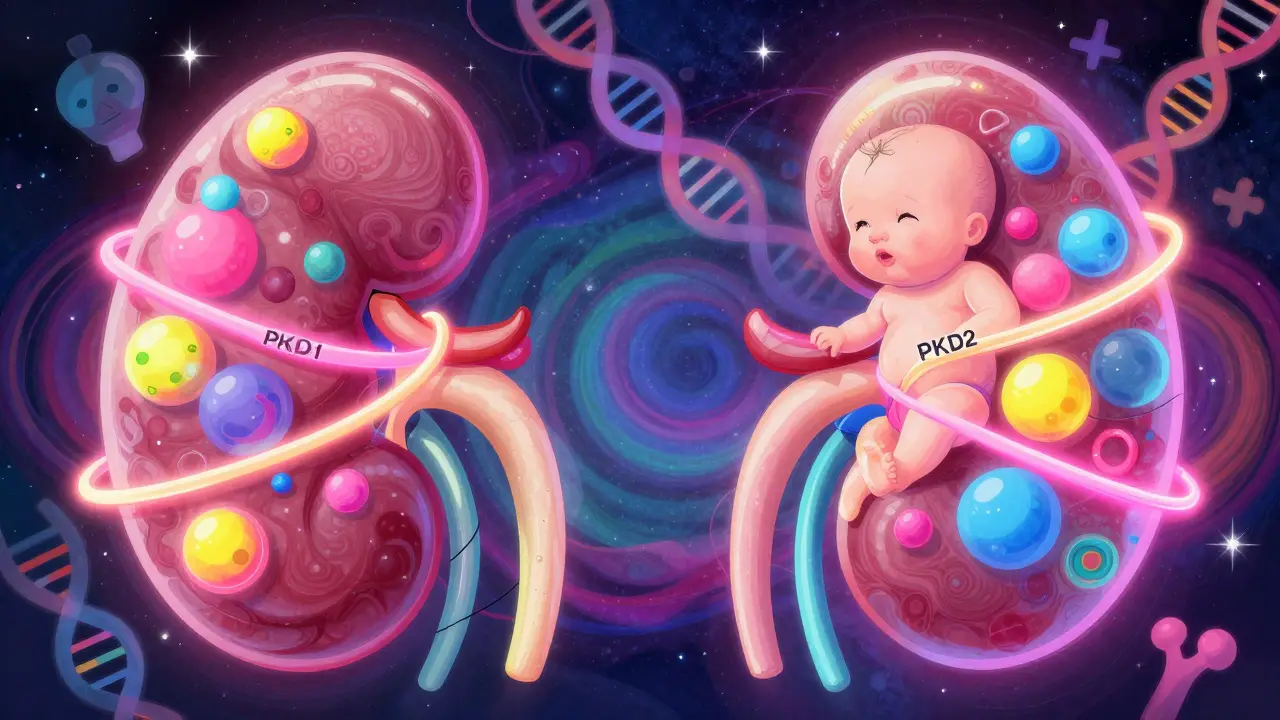
Polycystic kidney disease (PKD) isn't just about fluid-filled sacs in the kidneys. It's a lifelong battle shaped by your genes, where even a single faulty copy can set off a chain reaction that slowly destroys kidney function. Unlike many chronic conditions that creep in with age, PKD often starts quietly in your 20s or 30s-silent until the damage is done. And here’s the hard truth: if you have it, your kids have a 50% chance of inheriting it too.
What Exactly Is Polycystic Kidney Disease?
PKD is not one disease. It’s two. The big one is autosomal dominant polycystic kidney disease (ADPKD), which makes up over 90% of all cases. You only need one bad copy of either the PKD1 or PKD2 gene to get it. Most people inherit it from a parent, but about 1 in 10 cases happen without any family history-new mutations, out of nowhere.
The other type, autosomal recessive polycystic kidney disease (ARPKD), is rare. You need two bad copies of the PKHD1 gene-one from each parent. Parents usually don’t show symptoms. They’re carriers. But if both pass the mutation? Each child has a 1 in 4 chance of being born with ARPKD. This version often hits hard in infancy, with enlarged kidneys and high blood pressure showing up right after birth.
The cysts grow slowly, like balloons filling with fluid. Over time, they can swell kidneys to three or four times their normal size. Some kidneys in advanced PKD weigh up to 30 pounds. That’s heavier than a newborn baby. And as they expand, they crush healthy tissue, block blood flow, and mess with filtration. The result? Kidneys that can’t clean your blood anymore.
How It Progresses: ADPKD vs ARPKD
ADPKD and ARPKD don’t just differ in genetics-they differ in timing, severity, and how they hit your life.
For ADPKD, symptoms usually show up between ages 30 and 40. But that’s not set in stone. Some people notice high blood pressure in their 20s. Others don’t have symptoms until their 50s. The PKD1 mutation tends to be worse than PKD2. People with PKD1 often reach kidney failure 10-20 years earlier than those with PKD2. About half of ADPKD patients will need dialysis or a transplant by age 60.
ARPKD is a different story. It’s often diagnosed in newborns. Babies may have breathing problems because their enlarged kidneys press on the lungs. High blood pressure shows up early. About 50% of children with ARPKD develop kidney failure before age 10. But some survive into adulthood, especially with careful management.
Here’s the scary part: even within families, the disease can play out differently. Two siblings with the same gene mutation might have wildly different outcomes. One might need a transplant at 45. The other might make it to 70 with stable function. Why? We don’t fully know. Other genes, lifestyle, or even random chance seem to play a role.
Diagnosis: When and How It’s Found
Many people aren’t diagnosed until they have symptoms-pain in the sides, blood in urine, frequent infections, or uncontrolled high blood pressure. But if you have a family history, you don’t have to wait.
Ultrasound is the go-to tool. By age 30, if you have ADPKD and a family history, you’ll likely have at least 10 cysts in each kidney. MRI or CT scans can catch smaller cysts earlier, especially if you’re under 30. Genetic testing is now widely available and costs around $1,200. It’s not always needed-but it’s useful if:
- You’re planning a family and want to know your risk
- Your symptoms don’t match the usual pattern
- You’re adopted and don’t know your family history
Doctors don’t just look at cysts. They track kidney function with eGFR (estimated glomerular filtration rate). A normal eGFR is above 90. Once it drops below 60, you’re in stage 3 kidney disease. Below 15? You’re close to needing dialysis.
Managing the Disease: Beyond Waiting
There’s no cure. But there are tools to slow it down.
Control blood pressure like your life depends on it. The goal? Below 130/80 mmHg. For some, doctors aim even lower-110/75-based on studies showing it slows cyst growth. ACE inhibitors and ARBs are the first-line drugs. They do more than lower pressure-they reduce protein in urine, which protects the kidneys.
Tolvaptan (Jynarque) is the only FDA-approved drug that directly targets PKD progression. It blocks a hormone that makes cysts grow. In clinical trials, it slowed kidney function decline by about 1.3 mL/min per year. That might sound small, but over 10 years? It can delay dialysis by 5-10 years. The catch? It costs $115,000 a year. Insurance often covers it, but only if your disease is progressing fast-confirmed by imaging and eGFR decline.
Hydration matters. Drinking plenty of water (2-3 liters a day) may help slow cyst growth. It’s simple, cheap, and backed by animal studies. No one’s proven it works in humans yet, but many nephrologists recommend it.
Watch your diet. Low-salt, low-protein, and avoiding sugary drinks can help. High sodium raises blood pressure. Excess protein puts extra strain on kidneys. And sugary drinks? They’re linked to faster cyst growth in some studies.
Pain management is critical. About 78% of PKD patients report chronic pain. It’s not just from cysts-it’s from infections, bleeding inside cysts, or even kidney stones. Avoid NSAIDs like ibuprofen. They hurt kidneys. Acetaminophen is safer. Severe pain? Talk to your doctor about nerve blocks or cyst drainage.
The Emotional and Financial Toll
PKD doesn’t just attack your kidneys. It attacks your peace of mind.
One in two patients with ADPKD says they live with constant anxiety about kidney failure. The uncertainty is exhausting. Many feel guilty about passing it on. Others feel invisible-doctors overlook them until their kidneys are nearly gone.
Financially, it’s brutal. Annual costs average $45,300 per person in the U.S. That jumps to $95,700 in the year before dialysis. Insurance doesn’t always cover tolvaptan. Some patients skip doses or delay treatment because of cost. Medicare covers transplant and dialysis, but only after kidney failure hits. By then, you’ve already lost years of function.
But there’s hope. One patient, diagnosed at 28 with a family history, started blood pressure meds and hydration early. At 45, her eGFR is still at 65%. She’s not cured-but she’s buying time.
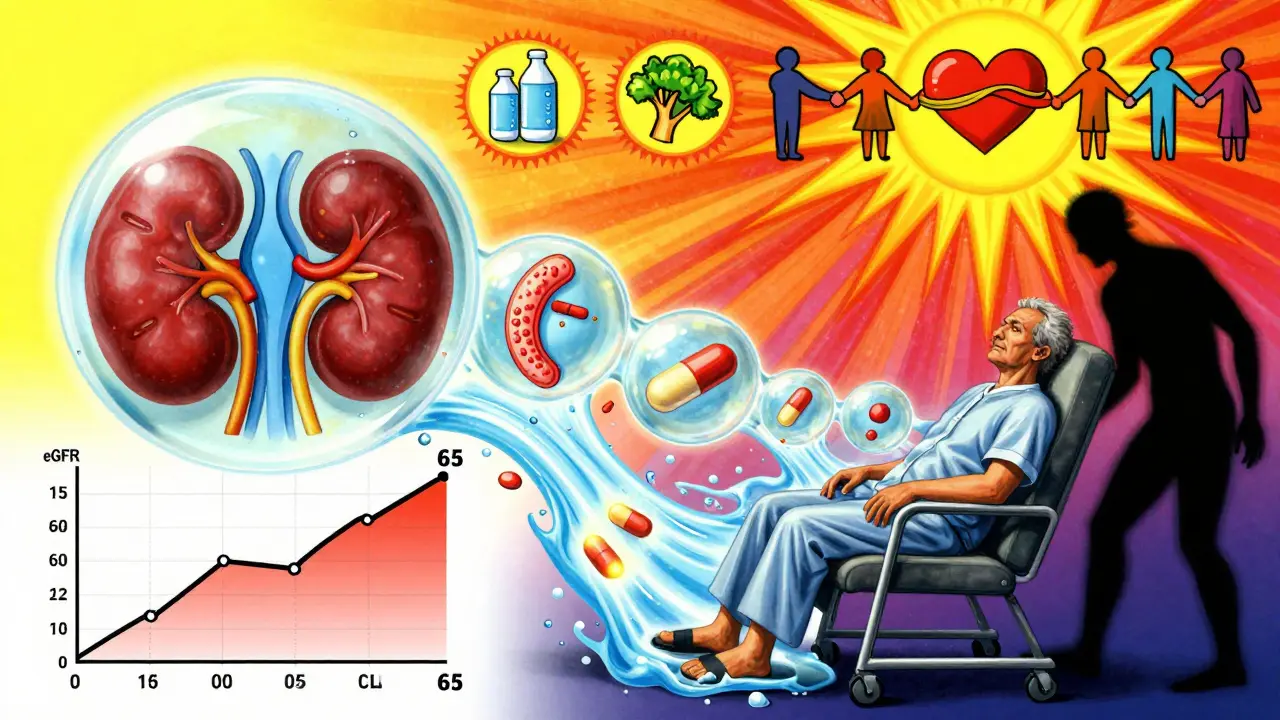
What’s Next? New Treatments on the Horizon
Research is accelerating. Three drugs are in phase 3 trials right now:
- Lixivaptan-a cousin of tolvaptan, possibly with fewer side effects. Results expected in 2024.
- Bardoxolone methyl-shows promise in improving eGFR by nearly 5 mL/min over 48 weeks in early trials.
- Vasopressin antagonists-next-gen versions of tolvaptan, aiming for better safety.
Gene therapy is still years away. But scientists are now editing the PKD1 gene in lab-grown kidney tissue. It’s early, but it’s real.
And screening is getting smarter. New AI tools can predict how fast cysts will grow based on early scans. That means treatment can start before damage becomes irreversible.
Final Thoughts: You’re Not Just a Patient
PKD is genetic. But your life isn’t determined by your DNA alone. Your choices-what you eat, how you manage stress, whether you get regular checkups-can change the trajectory.
If you have a family history, get tested. Don’t wait for pain. Don’t wait for high blood pressure. Early action saves kidneys. And if you’re already diagnosed? Stay on top of your numbers. Push for the right meds. Connect with support groups. You’re not alone. Over 600,000 people in the U.S. are walking this path. And new tools are coming faster than ever.
Is polycystic kidney disease always inherited?
No. While about 90% of ADPKD cases are inherited from a parent, roughly 10% happen because of a brand-new gene mutation. This means someone can be the first in their family to have PKD. The same applies to ARPKD-parents can be carriers without knowing it. Genetic testing can confirm whether a mutation is inherited or new.
Can you live a normal life with PKD?
Yes, many do. With early diagnosis, blood pressure control, and lifestyle adjustments, people with PKD can work, travel, raise families, and enjoy life for decades. The key is monitoring kidney function regularly and acting fast when problems arise. Some people never reach kidney failure. Others need a transplant in their 50s or 60s-still well within a normal lifespan.
Does tolvaptan cure PKD?
No. Tolvaptan slows the growth of cysts and delays kidney function decline, but it doesn’t stop the disease or reverse damage. It’s a management tool, not a cure. It also has side effects-like extreme thirst, frequent urination, and potential liver issues. It’s only prescribed for patients with rapidly progressing disease, and regular liver tests are required.
Can PKD affect other organs besides the kidneys?
Yes. Cysts can form in the liver, pancreas, and even the brain. Liver cysts are common in ADPKD but rarely cause serious problems. The bigger concern is brain aneurysms-especially if you have a family history of ruptured aneurysms. Doctors may recommend an MRI of the brain if you have multiple risk factors. High blood pressure also increases this risk.
Is kidney transplant a permanent solution?
A transplant replaces failed kidneys, but it doesn’t cure PKD. The cysts still grow in the original kidneys, but they’re no longer the source of harm. The new kidney doesn’t develop cysts. However, you’ll need lifelong immunosuppressants to prevent rejection. Transplant success rates are high-over 90% at five years. Many patients live 15-20 years or more with a transplant.
Lebogang kekana
March 4, 2026 AT 14:47Tildi Fletes
March 5, 2026 AT 16:35Deborah Dennis
March 6, 2026 AT 00:38Jessica Chaloux
March 7, 2026 AT 08:23Raman Kapri
March 8, 2026 AT 08:30Megan Nayak
March 8, 2026 AT 08:34RacRac Rachel
March 10, 2026 AT 04:40Levi Viloria
March 12, 2026 AT 03:42Dean Jones
March 12, 2026 AT 20:27Matt Alexander
March 13, 2026 AT 03:31Gretchen Rivas
March 13, 2026 AT 16:44Stephen Vassilev
March 14, 2026 AT 08:23Mike Dubes
March 15, 2026 AT 10:52John Cyrus
March 16, 2026 AT 22:05