
When you fill a prescription for a biologic drug like Humira or Enbrel, you might not realize that a cheaper version could be sitting on the shelf - and your pharmacist might swap it in without asking. That’s not a mistake. It’s interchangeability, a legal and regulatory tool in the U.S. that lets pharmacists automatically replace a brand-name biologic with a biosimilar - no doctor’s approval needed. But here’s the catch: not all biosimilars can do this. Only a handful have earned the FDA’s special interchangeability designation, and even then, whether you get swapped depends on where you live.
What’s the difference between a biosimilar and a generic?
Generics are copies of small-molecule drugs like ibuprofen or metformin. They’re chemically identical to the original. A generic pill has the same active ingredient, the same structure, the same way it works in your body. That’s why pharmacists can swap them without hesitation.
Biosimilars are different. They’re copies of biologic drugs - complex proteins made from living cells, not chemicals. Think insulin, rheumatoid arthritis treatments, or cancer drugs. Because they’re made by living systems, no two batches are exactly alike. Even slight changes in how they’re made can affect how they behave in your body. That’s why the FDA doesn’t call them generics. They’re called biosimilars - meaning they’re highly similar, but not identical.
Here’s the key point: all FDA-approved biosimilars are as safe and effective as the original. But only some are designated as interchangeable. That’s the only status that lets pharmacists switch them out automatically.
How does interchangeability work in the U.S.?
The U.S. is the only country in the world with a formal interchangeability pathway for biosimilars. It was created by the Biologics Price Competition and Innovation Act (BPCIA) in 2010. To earn this status, a biosimilar maker must prove more than just similarity. They need to show that switching back and forth between the original drug and the biosimilar doesn’t increase risk or reduce effectiveness.
The FDA requires at least two switches in clinical studies - for example, a patient takes the brand drug, then switches to the biosimilar, then switches back again. Researchers track things like immune response, side effects, and how the drug behaves in the bloodstream. If the data shows no clinically meaningful differences after multiple switches, the FDA grants interchangeability.
As of November 2023, the FDA has approved 41 biosimilars. Only 10 of them have interchangeability status. The first was Semglee (insulin glargine-yfgn), approved in July 2021. The first interchangeable monoclonal antibody was Cyltezo (adalimumab-adbm), approved in August 2023. These are big deals - insulin and adalimumab are among the most prescribed biologics in the country.
State laws make substitution a patchwork
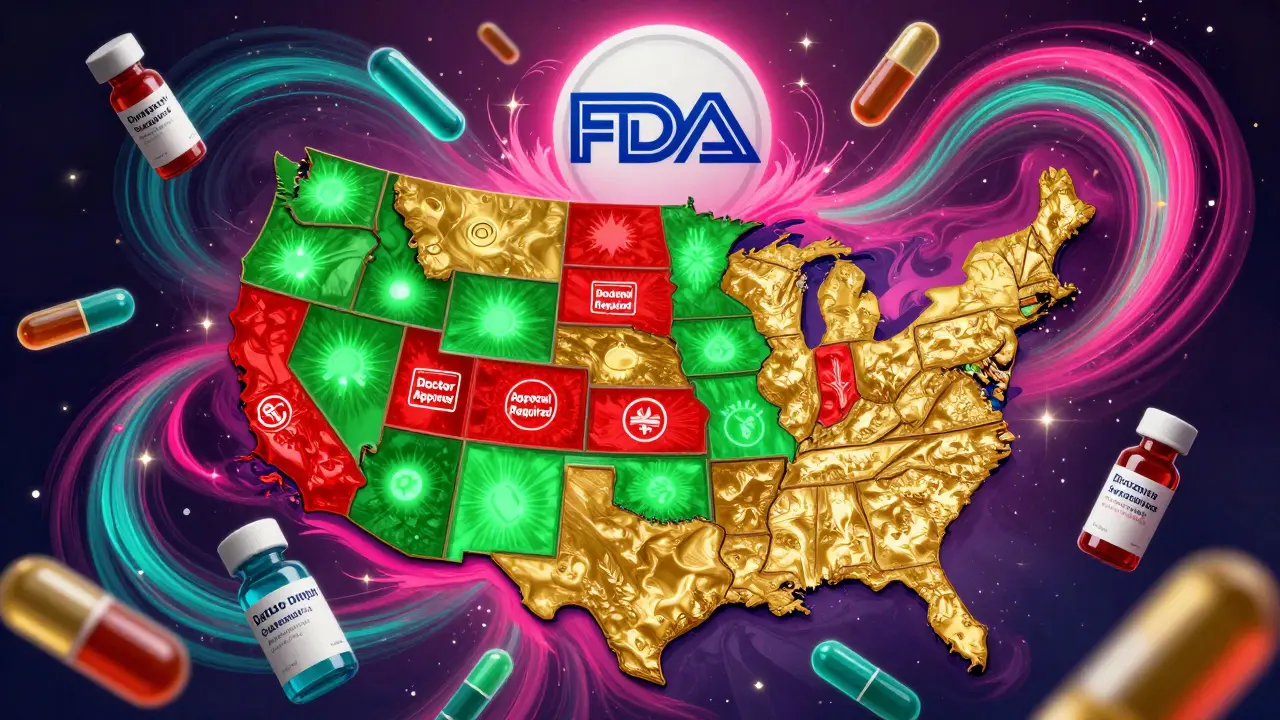
Even if a biosimilar is FDA-interchangeable, your pharmacist might not be allowed to swap it. That’s because each state has its own rules.
- 40 states, including Arizona and California, let pharmacists substitute without asking - as long as the drug is designated interchangeable and the prescriber hasn’t blocked it.
- 6 states and Washington D.C. only allow substitution if it saves the patient money.
- 4 states - Alabama, Indiana, South Carolina, and Washington - require the prescriber to approve the switch in advance.
Pharmacists have to juggle these rules every day. A pharmacist in New York might swap a biosimilar without telling you. One in Alabama can’t do it unless the doctor says so. And if you get your prescription filled in a different state - say, while traveling - the rules change again.
There’s also a reporting requirement. In most states, pharmacists must notify the prescriber within a few days, keep records for up to seven years, and document exactly which product was dispensed. Some states even require the patient to be informed in writing.
Why does this matter to patients?
Interchangeability is meant to cut costs. Biosimilars typically cost 15-30% less than the original biologic. For insulin, that can mean saving $800 a month - a life-changing difference for someone without good insurance.
But there are risks. Some patients report issues after being switched without warning. One patient on a psoriasis forum described an allergic reaction after their pharmacy automatically substituted a biosimilar. Turns out, they were sensitive to an inactive ingredient (an excipient) in the new version. The original drug didn’t have it.
A 2022 survey by the National Psoriasis Foundation found that 63% of patients were satisfied with their biosimilar, but 28% were worried they weren’t told about the switch. Transparency matters. If you’re stable on a drug, a sudden change - even to an FDA-approved alternative - can cause anxiety or side effects.
Studies show that non-medical switching can lead to higher discontinuation rates. One study in psoriasis patients found a 20.3% higher chance of stopping treatment after being switched to a biosimilar. That doesn’t mean biosimilars are unsafe - it means sudden changes without patient input can disrupt care.
What’s happening right now?
The market is shifting fast. In Q2 2023, biosimilars made up 34% of the volume of insulin and adalimumab prescriptions in the U.S., but only 22% of the revenue - because they’re cheaper. Semglee, the first interchangeable insulin, grabbed 17.3% of the market within six months. Non-interchangeable biosimilars took only 9.8% in the same time.
Insurance companies are pushing for automatic substitution. About 78% of commercial health plans now require it when state law allows. That means even if you prefer the brand, your insurer may block coverage unless you get the biosimilar.
Meanwhile, lawmakers are debating whether to eliminate the switching studies entirely. The Biosimilar Red Tape Elimination Act, introduced in 2022, would make every FDA-approved biosimilar interchangeable by default. Supporters say it’s needed to drive down prices. Critics, including PhRMA, warn it could compromise safety.
What should you do?
- Ask your doctor: Is my biologic eligible for a biosimilar? Is it interchangeable?
- Ask your pharmacist: Will you substitute? Do I need to sign anything? Will I be notified?
- Check your state’s law. You can find it through your state pharmacy board’s website.
- Keep track of what you’re taking. Note the manufacturer name on the bottle. If your drug changes unexpectedly, call your prescriber.
- If you’re stable and doing well, ask to stay on your current drug. Prescribers can block substitution with a "dispense as written" note or a DAW code on the prescription.
The goal of interchangeability is to make life-saving drugs more affordable. But it’s not a one-size-fits-all solution. It works best when patients are informed, pharmacists are trained, and doctors are part of the decision.
Can any biosimilar be automatically substituted?
No. Only biosimilars that have received the FDA’s specific "interchangeable" designation can be swapped automatically. As of late 2023, only 10 out of 41 approved biosimilars have this status. All others require the prescriber to specify "do not substitute" or for the pharmacist to get approval first.
Do all states allow pharmacists to substitute biosimilars without permission?
No. Forty states and Washington D.C. allow automatic substitution if the biosimilar is FDA-designated as interchangeable. Six states and D.C. only allow it if the switch saves the patient money. Four states - Alabama, Indiana, South Carolina, and Washington - require the prescriber’s explicit approval before substitution can happen.
Why does the FDA require switching studies for interchangeability?
Because biologics are made from living cells, they’re more complex than small-molecule drugs. Even minor manufacturing differences can affect how the body responds. Switching studies test whether alternating between the original and biosimilar over time causes safety issues or reduced effectiveness. The FDA requires at least two switches in a controlled study to ensure no clinically meaningful differences occur.
Can a pharmacist substitute one biosimilar for another?
No. Interchangeability designation only applies to switching between a biosimilar and its specific reference product - not between two different biosimilars. For example, if you’re on Cyltezo (an interchangeable biosimilar for Humira), your pharmacist can’t switch you to another biosimilar like Hyrimoz without a new prescription. This creates confusion, because multiple biosimilars may exist for the same drug, but only one can be swapped automatically.
Are biosimilars as safe as the original biologic?
Yes. The FDA requires all biosimilars - whether interchangeable or not - to meet the same strict standards for safety, purity, and potency as the original product. Clinical trials show they work just as well. The difference isn’t in safety - it’s in whether the law allows automatic substitution at the pharmacy counter.
Kenneth Jones
March 24, 2026 AT 20:10Stop pretending biosimilars are the same. They’re not. I’ve seen patients crash after switches. This isn’t savings-it’s a gamble with people’s lives.
Jefferson Moratin
March 25, 2026 AT 00:04The FDA’s interchangeability standard is a brilliant compromise. It acknowledges biological complexity without succumbing to fearmongering. The switching studies? Not red tape-they’re epistemological safeguards. We don’t just want similarity; we want *predictable interchangeability*. That’s science, not ideology.
When we treat biologics like aspirin, we ignore their ontological uniqueness. Living systems don’t produce clones. They produce nuanced variants. The FDA knows this. That’s why interchangeability isn’t automatic-it’s earned.
And yes, state patchwork is absurd. But it’s also predictable. Federalism isn’t broken here-it’s reflecting a deeper truth: healthcare isn’t a monolith. What works in California won’t always work in Alabama. The solution isn’t uniformity-it’s informed flexibility.
The real crisis isn’t substitution. It’s lack of transparency. If a pharmacist swaps without documentation, that’s a failure of process, not policy. Track the batch. Know the manufacturer. Demand audit trails. That’s patient empowerment.
And let’s not forget: 30% cost reduction on insulin isn’t a footnote. It’s a lifeline. For millions, the choice isn’t between ‘brand’ and ‘biosimilar.’ It’s between ‘medication’ and ‘bankruptcy.’
Caroline Dennis
March 25, 2026 AT 01:30Interchangeability = cost containment + clinical equivalence. No magic, no mystery. The data is clear: no increased immunogenicity, no drop in efficacy. The panic? Mostly anecdotal. And yes, excipient sensitivity happens-but that’s why we document. Not to stop substitution, but to refine it.
Pharmacists aren’t villains. They’re gatekeepers of access. If you’re stable, ask for DAW-1. If you’re not? Let them swap. Evidence > fear.
Korn Deno
March 27, 2026 AT 00:50People keep saying ‘biosimilars aren’t generics’ like it’s a flaw. It’s not. It’s precision. You wouldn’t swap a handcrafted violin for a factory model and call it the same. But you’d swap two Stradivarius replicas if they played the same. That’s biosimilars. Not identical. Not inferior. Just… different paths to the same note.
And yeah, state laws are a mess. But guess what? So is the rest of healthcare. We fix the system, not the symptom.
Raphael Schwartz
March 27, 2026 AT 18:08america is weak. why let some pharmacist decide what i take? my doc should have total control. this is like letting a cashier pick your heart med. stupid.
Zola Parker
March 29, 2026 AT 14:15So… we’re letting robots swap life-saving drugs now? 😅
Next they’ll replace your therapist with a chatbot. 🤖💔
florence matthews
March 31, 2026 AT 10:52I’ve lived in 3 countries. In Canada, they swap without a second thought. In Germany, doctors approve everything. Here? We’re stuck in this weird middle ground. Maybe we need a national standard… but also maybe we need to listen to patients more than laws.
I’m not anti-biosimilar. I’m pro-transparency. Just tell me what’s in the bottle.
Marissa Staples
April 1, 2026 AT 03:54My mom was switched to a biosimilar for RA. She didn’t tell anyone. Got worse. Then got hospitalized. No one asked if she was okay with it. Just… swapped. Now she’s scared to even refill. This isn’t healthcare. It’s cost-cutting with a smile.
Stephen Alabi
April 3, 2026 AT 00:20It is axiomatic that the regulatory apparatus governing biological therapeutics must be predicated upon an evidentiary foundation of unparalleled rigor. The notion that interchangeability may be conferred upon a product based upon statistical equivalence, without exhaustive longitudinal pharmacovigilance, constitutes a profound epistemic vulnerability.
Furthermore, the proliferation of state-level regulatory variance undermines the principle of federal uniformity in pharmaceutical oversight, which is a cornerstone of the U.S. constitutional framework.
It is therefore imperative that the FDA, in concert with the Centers for Medicare & Medicaid Services, institute a mandatory, centralized, blockchain-enabled prescribing and dispensing audit trail-complete with real-time immunogenicity monitoring via wearable biometric sensors.
Pat Fur
April 3, 2026 AT 20:38Just wanted to say-I switched to Semglee last year. Saved $900/month. No issues. My doctor said it was fine. My pharmacist texted me before filling. That’s how it should be. Simple. Clear. Respectful.
Not every switch is a disaster. Some are just… better.
Linda Foster
April 4, 2026 AT 20:56The FDA’s interchangeability criteria are methodologically sound and empirically validated. The requirement for multiple-switch studies ensures that pharmacokinetic and immunogenic profiles remain within acceptable bioequivalence parameters. The current regulatory framework aligns with ICH guidelines and reflects international consensus on biosimilar evaluation.
State-level variations, while administratively complex, are constitutionally permissible under the Tenth Amendment. Regulatory federalism is not a flaw-it is a feature of American governance.
Caroline Bonner
April 5, 2026 AT 05:06Okay, so I’m from Canada, and honestly, we just swap biosimilars all the time-it’s automatic, no big deal. We don’t have all this state-by-state nonsense. Our pharmacists are trained, we have national databases, and patients are informed via plain-language leaflets. No drama. No fear. Just… better access.
Here in the U.S., I feel like we’re overcomplicating something that’s fundamentally simple: if it’s FDA-approved and proven safe, why not let the pharmacist do their job? We trust them with antibiotics, statins, even opioids-why not this?
Also, the idea that a patient might be sensitive to an excipient? That’s not a reason to block substitution-it’s a reason to improve labeling. Every bottle should have a QR code that links to a full ingredient list, with allergens highlighted. Simple. Digital. Transparent.
And yes, I know some people get nervous about change. But we don’t stop vaccines because someone had a bad reaction. We study it, we improve, we communicate. That’s what we need here too. Not fear. Not bureaucracy. Just clarity.
Let pharmacists help. Let patients know. Let doctors stay in the loop. And let’s stop pretending this is a political issue. It’s a healthcare one.
Grace Kusta Nasralla
April 5, 2026 AT 14:31I just… I can’t stop thinking about the woman who had the allergic reaction. What if it was me? What if I never knew why I got sick? This isn’t about money. It’s about trust.
Caroline Dennis
April 5, 2026 AT 21:18Exactly. And that’s why documentation matters. Not to scare people. To protect them. A system that tracks substitutions isn’t bureaucracy-it’s care.