
When you’re on a daily medication for high blood pressure, diabetes, or cholesterol, taking your pills isn’t just a habit-it’s a lifeline. But here’s the hard truth: half of all people who take generic medications stop taking them within a year. It’s not laziness. It’s forgetfulness, confusion, cost stress, or just life getting in the way. And for generics-cheaper, equally effective copies of brand-name drugs-there’s often no built-in support system. No free apps. No nurse check-ins. No reminders. That’s where digital adherence tracking comes in.
Why Generics Need Digital Tracking More Than Brand Names
Brand-name drugmakers invest millions in adherence programs. They send text reminders. Offer co-pay cards. Mail refill alerts. Generics? Not so much. In the U.S., generics make up 90% of all prescriptions. But they’re sold by dozens of different manufacturers, often without any patient support infrastructure. That leaves patients on their own.And the cost of skipping doses? $300 billion a year in the U.S. alone. That’s emergency room visits, hospitalizations, and worsening conditions-all preventable. For chronic conditions like hypertension or heart failure, missing even one or two doses a week can spike your risk of stroke or heart attack. Digital tools don’t just track pills-they save lives.
How Digital Adherence Tools Actually Work
These aren’t simple phone alarms. Real digital adherence tools use smart packaging, sensors, and cloud platforms to prove you took your medicine-not just say you did.Take the MEMS AS system. It’s used in clinical trials worldwide. Each pill bottle has a tiny electronic cap that records every time it’s opened. That data gets sent to a secure server. Algorithms then analyze patterns: Did you open it at 8 a.m. like prescribed? Did you skip two days? Did you take two doses in one hour? It’s accurate to nearly 100% in controlled settings.
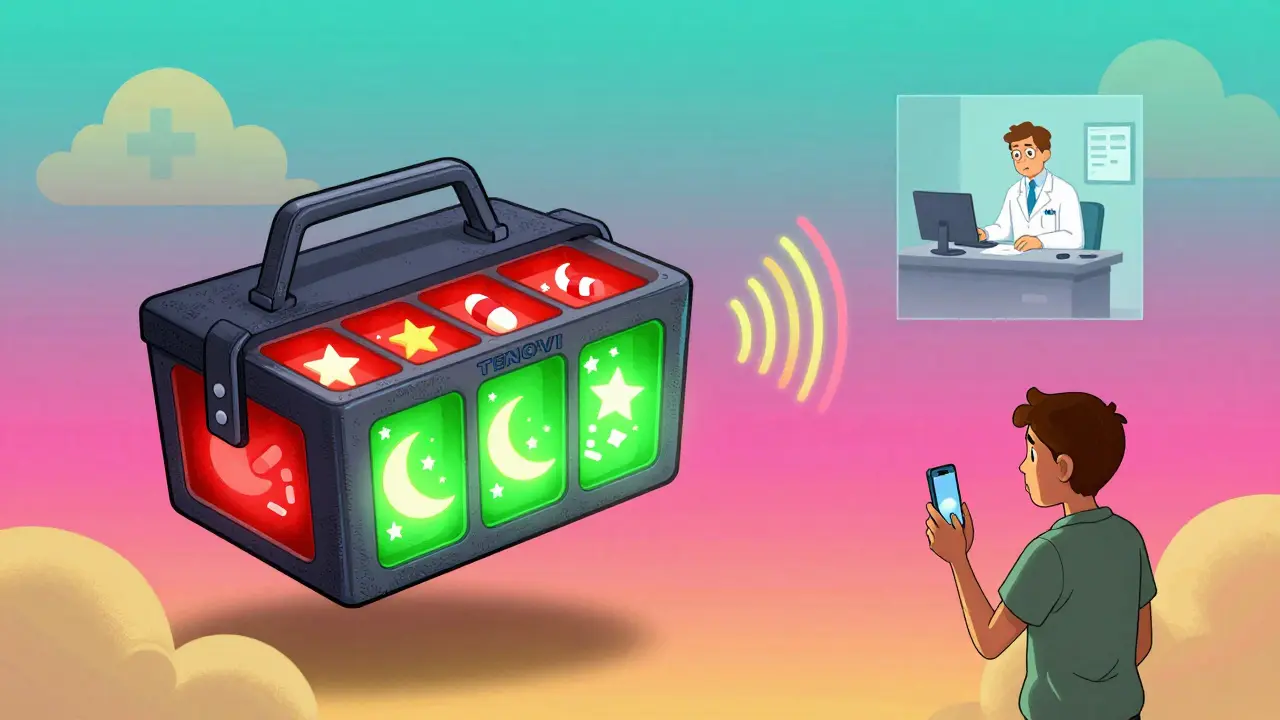
Then there’s the Tenovi Pillbox. It’s a physical box with slots for up to four daily medications. Each compartment has an LED light: red means “take this,” green means “done.” It connects via cellular signal (no Wi-Fi needed) and sends real-time updates to your pharmacist or doctor. It even alerts caregivers if you miss a dose. One user with heart failure said it cut his missed doses from 8 a week to 1.
Other tools include:
- Wisepill: Electronic blister packs that beep and text when it’s time to take a pill.
- VDOT: Video-based monitoring where you film yourself swallowing pills-used mostly for TB and mental health meds. It’s 95% accurate but feels invasive to many.
- ReX System: A smart dispenser that only releases pills at scheduled times. No overuse. No skipping.
All these tools sync with major electronic health records like Epic and Cerner. That means your doctor sees your adherence data right in their chart-not a paper log or a memory.
What Works Best? Comparing the Top Systems
Not all tools are built the same. Here’s how the main options stack up:
| Tool | Accuracy | Cost | Best For | Downsides |
|---|---|---|---|---|
| MEMS AS | 100% (clinical trials) | $500+ (usually covered by trials or insurers) | Research, hospitals, complex regimens | Not designed for daily patient use. No visual reminders. |
| Tenovi Pillbox | 92-95% | $149 device + $30/month | Chronic conditions, elderly, polypharmacy | Battery drains fast. Monthly fee adds up. |
| Wisepill | 85-90% | $120 per blister pack (reusable device) | Single daily meds, low-tech users | Only tracks one pill type at a time. |
| VDOT | 95% | Free to $100/month (insurance-dependent) | Psychiatric, TB, high-risk patients | 30% quit due to privacy concerns. |
| McKesson APS | 70-80% (claims-based) | $99-$299/month (for pharmacies) | Pharmacies tracking refill patterns | Can’t tell if you actually swallowed the pill. |
McKesson’s system, for example, doesn’t track actual ingestion. It just sees when you refill your prescription. If you refill early, it assumes you’re non-adherent. But what if you lost your pills? Or your dog ate them? That’s a false negative. Real tracking tools know when you opened the bottle or swallowed the pill-not just when you bought it.
Real-World Problems: What Patients and Pharmacists Say
Tools look great on paper. But in practice? They’re messy.
One pharmacist in Ohio told Reddit users her pharmacy used McKesson’s dashboard. Adherence for diabetes meds jumped from 62% to 78% in 18 months. But they had to hire a full-time tech just to manage the data. “It’s not plug-and-play,” she wrote. “You need staff to interpret the alerts.”
On Amazon, Tenovi users give it 4.2 stars. But the top complaint? “The cellular hub dies every three days.” That’s not a dealbreaker for some, but for an 80-year-old with arthritis, recharging a gadget every 72 hours is a burden.
And then there’s the privacy issue. A 2022 AHRQ survey found 63% of patients worried their adherence data could be sold, shared, or used to deny insurance. No one wants their pharmacy to know they skipped their blood pressure pills because they couldn’t afford them.
Who Should Use These Tools-and Who Shouldn’t
These aren’t for everyone. But they’re perfect for some.
Use them if:
- You take 5+ medications daily
- You’ve missed doses before
- You have a chronic condition (diabetes, heart disease, COPD)
- You live alone or have memory issues
- Your doctor or pharmacist is worried about your adherence
Avoid them if:
- You only take one pill a day and have a strong routine
- You can’t afford the monthly fees
- You’re uncomfortable with constant monitoring
- You’re tech-averse and won’t use a smartphone
For many, simple solutions work better: pill organizers with alarms, family check-ins, or even pharmacy refill alerts. But for those on complex regimens, digital tools aren’t luxury-they’re necessity.

How to Get Started
If you think you need help:
- Ask your pharmacist: “Do you offer any adherence tracking for my meds?” Many now partner with Tenovi, Wisepill, or McKesson.
- Check if your insurance covers remote therapeutic monitoring (RTM). Medicare Advantage plans are starting to pay for it-but only 38% currently do.
- Try a free app first. Medisafe or MyTherapy offer reminders and logs. They’re not as accurate as smart packaging, but they’re better than nothing.
- If you’re on a fixed income, ask about patient assistance programs. Some companies offer discounted or free devices for low-income users.
- Don’t wait for a crisis. If you’ve missed a dose in the last month, it’s time to act.
Pharmacists are now trained to do 3-minute adherence checks during pickup. Just ask: “Am I taking my meds right?” They’ll know what to do.
The Future: AI, Predictions, and Integration
The next wave isn’t just tracking-it’s predicting. CVS Health is testing AI that scans your refill history, pharmacy visits, and even weather data to guess who’s at risk of skipping doses. In trials, it flagged at-risk patients 22% better than old methods.
By 2025, experts say only 3-5 big platforms will dominate. They’ll be built into pharmacy benefit managers like Express Scripts or Optum. Your doctor won’t just see your adherence score-they’ll see a risk alert: “Patient X has 70% chance of non-adherence next month. Recommend intervention.”
And the payoff? For every $1 spent on adherence tools for heart meds, the system saves $7.20 in hospital costs. That’s why CMS is now tying Medicare Star Ratings to adherence scores. Pharmacies that improve adherence get more money. Patients get better care. Everyone wins.
But the real win? When taking your pills stops being a chore-and starts being a habit, supported by smart tech, not guilt.
Are digital adherence tools covered by insurance?
Only in some cases. Medicare Advantage plans started covering remote therapeutic monitoring (RTM) in 2022, but only 38% currently do. Private insurers vary widely. Devices like Tenovi or Wisepill are rarely covered outright, but some employers or pharmacy benefit managers offer them as part of chronic disease programs. Always ask your pharmacist or insurer before buying.
Can these tools tell if I actually swallowed the pill?
Most don’t. Electronic caps and pillboxes track when you open the container. Video-based systems like VDOT do confirm swallowing, but they’re invasive and used mostly for high-risk cases like tuberculosis. Ingestible sensors (like Proteus) can confirm ingestion, but they’re expensive and not widely available for generics. For now, opening the bottle is the best proxy we have.
Do these tools work for elderly patients?
Yes, but only if designed for them. Tenovi’s LED lights and simple interface work well for seniors. MEMS AS requires smartphone use and is harder for older users. The key is matching the tool to the person’s tech comfort level. Many seniors prefer physical devices with big buttons and visual cues over apps. Always involve a family member in setup.
What’s the difference between a pill reminder app and a real adherence tool?
Apps like Medisafe rely on you to tap “taken.” That’s self-reported data-unreliable. Real adherence tools use sensors, electronics, or video to prove you took the pill. They don’t ask you to remember. They record it. That’s why clinical studies trust sensor-based tools but ignore app data.
Can my doctor see my adherence data without me knowing?
No. Legally, your data belongs to you. Most platforms require explicit consent before sharing with providers. But some pharmacy systems (like McKesson APS) use refill data that’s automatically shared with insurers and doctors. Always ask how your data is used and who can access it before signing up.
Are these tools safe for people with dementia?
They can be-but only with caregiver support. Tools like Tenovi can send alerts to family members if doses are missed. But patients with advanced dementia often can’t operate the devices themselves. In those cases, the best solution is a caregiver-managed system with automated alerts and refill coordination.
Final Thought: It’s Not About Surveillance-It’s About Support
Digital adherence tools aren’t about spying on you. They’re about helping you stay healthy when life gets busy, confusing, or overwhelming. For people on generics, they’re the closest thing to a personal health coach you can get-without the price tag of a nurse visiting daily.
The goal isn’t perfection. It’s progress. One less missed dose. One fewer hospital visit. One more day feeling well. That’s what these tools are really for.
Josh josh
January 25, 2026 AT 04:48Sally Dalton
January 26, 2026 AT 21:25Karen Droege
January 28, 2026 AT 03:51Jessica Knuteson
January 28, 2026 AT 20:16Neil Thorogood
January 29, 2026 AT 07:54Mohammed Rizvi
January 29, 2026 AT 17:45Ashley Karanja
January 31, 2026 AT 15:51Robin Van Emous
February 1, 2026 AT 14:57Geoff Miskinis
February 3, 2026 AT 11:57eric fert
February 5, 2026 AT 03:09Betty Bomber
February 5, 2026 AT 17:08bella nash
February 7, 2026 AT 15:29Angie Thompson
February 8, 2026 AT 14:36