
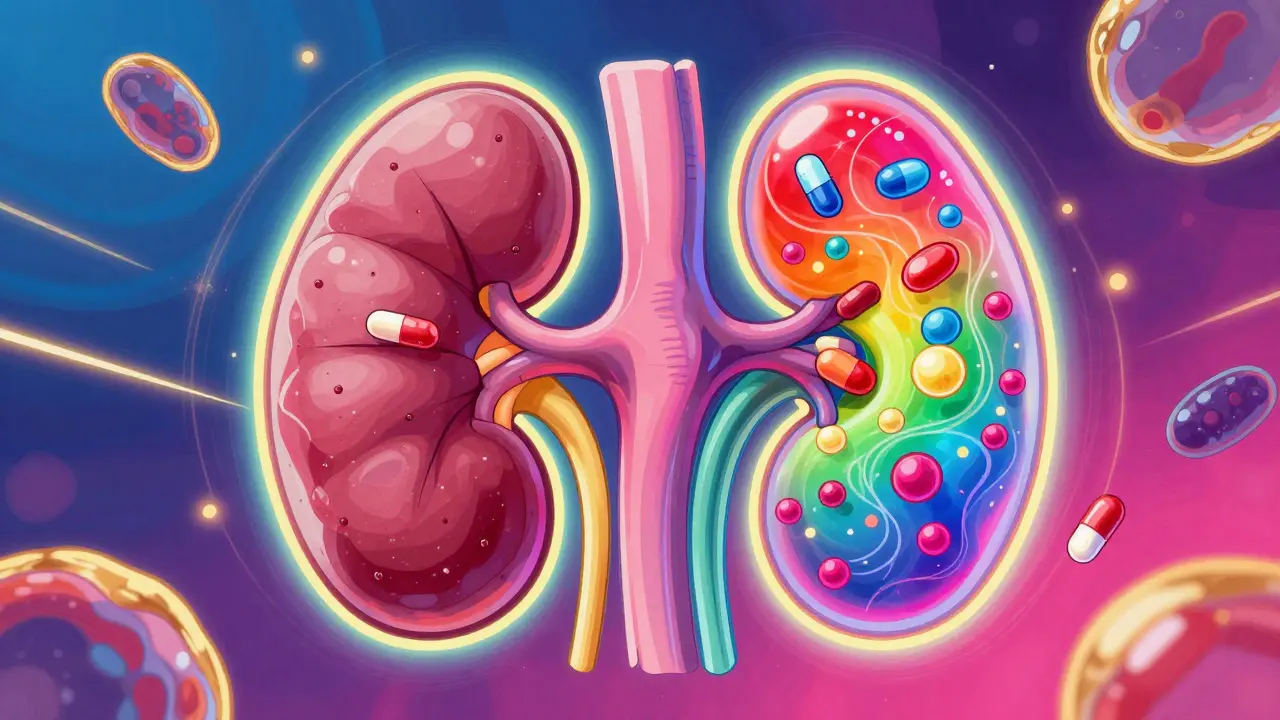
Aminoglycoside Nephrotoxicity Risk Calculator
Your Risk Level
Enter your information to see your risk level.
Key findings from the article:
Up to one in four people taking aminoglycosides develop kidney damage. Risk increases with age, pre-existing kidney disease, and concurrent use of other nephrotoxic drugs like vancomycin.
Once-daily dosing reduces risk by 30-50% compared to multiple doses. Monitoring serum creatinine every 48-72 hours is critical.
When you’re fighting a serious bacterial infection, especially one caused by tough Gram-negative bugs like E. coli or Pseudomonas, doctors often turn to aminoglycoside antibiotics. Drugs like gentamicin, tobramycin, and amikacin work fast and kill bacteria dead. But there’s a hidden cost: up to one in four people who take them will develop kidney damage. This isn’t rare. It’s predictable. And it’s preventable-if you know what to watch for.
How Aminoglycosides Hurt the Kidneys
These antibiotics don’t just float through your body. About 5% of every dose gets stuck in the proximal tubules-the part of your kidney that reabsorbs nutrients and filters waste. Once there, they build up inside tiny sacs called lysosomes. Over time, these sacs swell, fill with abnormal lipid deposits called myeloid bodies, and start breaking down. The cells lining your tubules begin to die. This isn’t inflammation. It’s slow, silent cellular suicide. What makes it worse is that this damage doesn’t show up right away. Most people don’t notice anything until after five or seven days of treatment. By then, your kidneys are already struggling. Your serum creatinine rises. Your urine output stays normal (that’s why it’s called nonoliguric), but your body can’t clear waste the way it should. You might feel tired. Your legs might swell. But without a blood test, you wouldn’t know it’s the antibiotic causing it.Why Some People Are at Higher Risk
Not everyone gets kidney damage from aminoglycosides. But certain factors make it way more likely. If you’re over 65, your kidneys are already working harder to keep up. If you’ve got baseline kidney disease-say, an eGFR below 60-you’re 3.2 times more likely to crash into acute kidney injury. And if you’re on another nephrotoxic drug, like vancomycin? Your risk jumps 2.7 times. Dehydration is another silent killer here. When you’re low on fluids, your kidneys filter less blood. That means more aminoglycoside sticks around in the tubules instead of getting flushed out. Even a mild fever or not drinking enough water for a couple of days can tip the balance. And yes, the dose matters. But it’s not just about how much you get-it’s how often. Giving the same total daily dose split into three smaller shots causes more damage than giving it all at once. That’s because your kidneys don’t get a chance to clear the drug between doses. Once-daily dosing is now the standard for good reason: it lowers nephrotoxicity without hurting effectiveness.What Doctors Look For
There’s no single test that says, “Yes, this is aminoglycoside kidney damage.” But doctors have a checklist. First, they track your serum creatinine. A rise of 0.5 mg/dL or 50% above your baseline is a red flag. Second, they check your urine. Early signs include higher levels of sodium, potassium, magnesium, and calcium spilling out-signs your tubules aren’t reabsorbing properly. They also look for proteins like beta-2-microglobulin and enzymes like N-acetylglucosaminidase, which leak out when tubule cells die. You won’t see this on a regular urine dipstick. You need a specialized lab test. That’s why monitoring isn’t optional-it’s mandatory. Guidelines say check creatinine every 48 to 72 hours. If you’re on gentamicin, your trough level (the lowest point before your next dose) should stay under 1 μg/mL. Go above that, and your risk spikes.
What Happens After You Stop?
The good news? Your kidneys are tough. Once you stop the drug, recovery often starts within three to five days. Most people bounce back fully in one to three weeks. A 2021 study of over 1,200 patients showed that 82% regained normal or near-normal kidney function within 30 days of stopping aminoglycosides. But not everyone does. About 1 in 5 end up with permanent loss of kidney function. That’s not just a lab number-it means higher risk for heart disease, fluid overload, and needing dialysis later on. That’s why even after you feel better, your doctor should keep checking your kidney function for weeks after treatment ends.What’s Being Done to Fix This?
For decades, the only strategy was to monitor closely and hope for the best. But research is shifting. Scientists now know it’s not just about tubule damage-it’s also about blood flow. Aminoglycosides cause your kidney’s blood vessels to constrict. That reduces filtration even before cells start dying. This dual mechanism-tubular toxicity plus vascular narrowing-explains why some people crash even with perfect drug levels. One of the most promising breakthroughs? Polyaspartic acid. In lab studies, it blocks aminoglycosides from latching onto kidney cells. It stops the lipid buildup. It prevents lysosomal damage. In rats, it completely protected kidneys even at high doses. Human trials are now underway. A modified version is in Phase II testing as of late 2023. If it works, this could be the first real shield against aminoglycoside toxicity. Meanwhile, researchers are also looking at antioxidants that target mitochondrial damage. Aminoglycosides mess with your cells’ energy factories, creating toxic free radicals. Blocking that process might stop the chain reaction before it starts.
Why We Still Use Them
You might wonder: if they’re this dangerous, why are we still using them? Because for some infections, there’s no better option. Multidrug-resistant pneumonia, sepsis from hospital-acquired bacteria, complicated UTIs in ICU patients-these are life-or-death situations. Aminoglycosides are one of the few drugs that still work. The World Health Organization estimates 12.5 million treatment courses are given worldwide each year. That’s not because doctors are careless. It’s because they’re making a calculated choice: risk kidney damage to save a life. The goal isn’t to stop using them. It’s to use them smarter. Once-daily dosing. Avoiding other kidney toxins. Keeping patients well-hydrated. Monitoring levels. Watching for early signs. These aren’t just best practices-they’re survival tactics.What You Can Do
If you’re prescribed an aminoglycoside, ask these questions:- Is this the best option, or is there a safer alternative?
- Will I get this once a day or multiple times?
- How often will my kidney function be checked?
- What’s my target trough level?
- Should I avoid NSAIDs, contrast dye, or vancomycin while on this?
- What symptoms should I report right away-fatigue, swelling, less urine, dizziness?
The Bottom Line
Aminoglycosides are powerful, dangerous, and still essential. Their kidney damage isn’t a side effect-it’s a known, predictable, and preventable consequence. We’ve known how they hurt the kidneys for over 50 years. We’ve known how to reduce the risk for decades. But too often, we still treat them like any other antibiotic. It’s time to stop that. Treat them like the high-risk tools they are. Monitor. Adjust. Protect. And never assume normal urine output means normal kidneys.Can aminoglycosides cause permanent kidney damage?
Yes, in about 1 in 5 cases, aminoglycoside use leads to permanent loss of kidney function. Most people recover fully, especially if the drug is stopped early and no other kidney stressors are present. But older adults, those with pre-existing kidney disease, or those on long courses are at higher risk for lasting damage.
Is gentamicin more toxic than amikacin?
Yes, gentamicin has higher nephrotoxic potential than amikacin at equivalent doses. Studies show gentamicin accumulates more in kidney cells and causes more severe tubular damage. That’s why amikacin is often preferred for longer treatments or in patients with higher risk factors.
Why is once-daily dosing safer than multiple doses?
Once-daily dosing lets your kidneys clear most of the drug between doses, reducing buildup in tubule cells. Multiple daily doses keep drug levels consistently high, increasing exposure time and cellular damage. Studies show once-daily regimens lower nephrotoxicity rates by 30-50% without reducing effectiveness.
Can I take ibuprofen while on gentamicin?
No. NSAIDs like ibuprofen reduce blood flow to the kidneys and can worsen aminoglycoside toxicity. Even short-term use increases your risk of acute kidney injury. Always check with your doctor before taking any pain relievers while on these antibiotics.
How long does it take for kidneys to recover after stopping aminoglycosides?
Recovery usually begins 3-5 days after stopping the drug. Most people see full kidney function return within 1-3 weeks. But recovery can take longer in older adults or those with other health problems. Some patients never fully recover, especially if damage was severe or treatment lasted more than 10 days.
Are there any drugs that protect the kidneys from aminoglycoside damage?
Currently, no drug is approved for clinical use to prevent aminoglycoside nephrotoxicity. However, polyaspartic acid has shown strong protective effects in animal and lab studies by blocking the drug from binding to kidney cells. Human trials are underway, but until then, the best protection is careful dosing, monitoring, and avoiding other kidney stressors.
Andrew Freeman
January 15, 2026 AT 12:44Susie Deer
January 16, 2026 AT 02:45TooAfraid ToSay
January 16, 2026 AT 11:34Allison Deming
January 18, 2026 AT 08:39Dylan Livingston
January 19, 2026 AT 21:57says haze
January 20, 2026 AT 09:52Anna Hunger
January 21, 2026 AT 10:37Alvin Bregman
January 22, 2026 AT 13:01Sarah -Jane Vincent
January 23, 2026 AT 19:15Henry Sy
January 24, 2026 AT 17:25Jason Yan
January 26, 2026 AT 04:37