
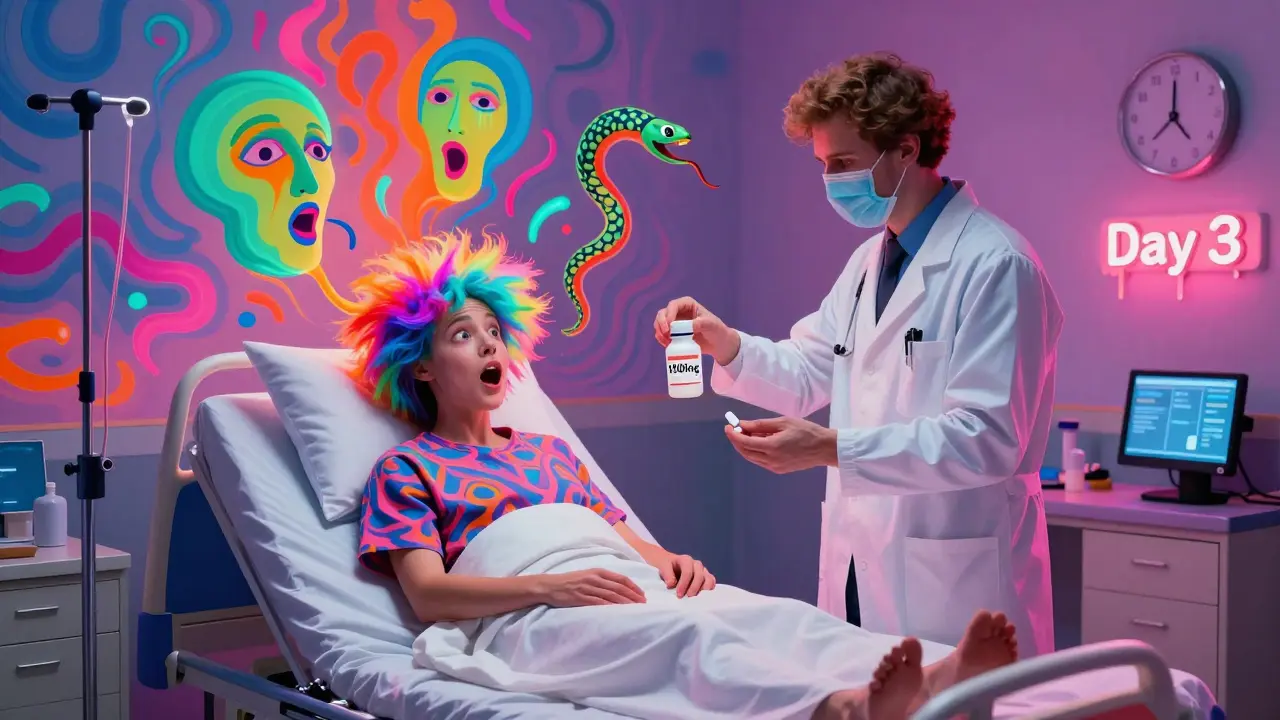
Steroid Psychosis Risk Calculator
Steroid Dose Assessment Tool
Calculate your risk of steroid-induced psychosis based on current steroid dose. This tool uses clinical guidelines to assess your risk level and provides immediate treatment recommendations.
Results
Recommended Action:
Key Fact:
Symptoms to Watch For
- Early stage (days 1-3): Confusion, restlessness, irritability
- Mid stage (days 3-7): Delusions, hallucinations, paranoia
- Advanced stage: Aggression, violence, suicidal thoughts
When someone starts taking high-dose steroids for asthma, lupus, or a severe flare-up, they usually expect improved breathing, less swelling, or reduced pain. But in about 6% of cases, something far more dangerous happens: they develop psychosis. Hallucinations. Paranoia. Aggression. Confusion. And if you don’t recognize it fast, it can turn into a medical emergency.
What Exactly Is Steroid-Induced Psychosis?
Steroid-induced psychosis isn’t just "feeling weird" after a shot of prednisone. It’s a real, diagnosable condition listed in the DSM-5 as a substance/medication-induced psychotic disorder. That means the person must have clear psychotic symptoms-like hearing voices or believing things that aren’t true-that started within days of starting corticosteroids and can’t be blamed on anything else, like drug use, a brain tumor, or an existing mental illness.
The numbers are startling. For patients getting more than 80 mg of prednisone daily, nearly 1 in 5 develop psychiatric symptoms. Even at lower doses-40 mg or more-about 1 in 20 will show signs. These aren’t rare outliers. They’re predictable side effects tied directly to dose and timing.
Most cases show up within the first five days. Sometimes as early as 24 hours. Early warning signs aren’t dramatic. They’re subtle: a patient who was calm suddenly seems confused, restless, or overly suspicious. They might forget where they are, repeat questions, or seem unusually irritable. If you miss these, you might wait until they’re screaming at imaginary people or trying to jump out a window.
How Do Steroids Cause Psychosis?
Steroids like prednisone, dexamethasone, and methylprednisolone mimic cortisol-the body’s natural stress hormone. But they don’t work the same way. They flood the brain with synthetic glucocorticoids, overwhelming receptors that regulate mood, memory, and perception. This disrupts the HPA axis (the brain-body system that controls stress response), leading to chemical imbalances that mirror what’s seen in Cushing’s syndrome or even severe depression.
It’s not just about too much hormone. It’s about imbalance. Glucocorticoid receptors get overstimulated while mineralocorticoid receptors are under-stimulated. That mismatch messes with neurotransmitters like serotonin and dopamine. The result? Cognitive fog, emotional volatility, and eventually, full-blown psychosis.
Interestingly, the type of symptoms often depends on how long the steroids are taken. Short-term use (a few days to weeks) tends to trigger mania or agitation. Long-term use (months) more often leads to depression or apathy. But psychosis? That can happen at any time-and it’s the most urgent.
Recognizing the Emergency: Symptoms to Watch For
Not every patient on steroids will go psychotic. But if they do, the signs follow a pattern:
- Early stage (days 1-3): Confusion, restlessness, irritability, trouble sleeping, difficulty concentrating.
- Mid stage (days 3-7): Delusions (false beliefs), hallucinations (seeing or hearing things), paranoia, disorganized speech.
- Advanced stage: Aggression, violence, suicidal thoughts, extreme agitation, inability to recognize family or caregivers.
One study of 79 patients found that 28% developed mania, 40% depression, and 14% full psychosis. But in an emergency room, you don’t wait for the full picture. You act when the person becomes unsafe.
Don’t assume it’s "just anxiety" or "they’re stressed about being sick." If someone on steroids suddenly believes their IV is a tracking device, or that the nurses are trying to poison them, that’s not normal. That’s psychosis.

Step-by-Step Emergency Management
When a patient presents with acute psychosis after steroid use, time is everything. Here’s what works:
- Ensure safety first. Remove sharp objects. Calm the environment. Use verbal de-escalation. Never escalate the situation with force unless absolutely necessary.
- Confirm steroid exposure. Ask: What steroid? What dose? When did they start? How long have they been taking it? Symptoms must align with the timeline.
- Rule out mimics. Run basic labs: blood sugar, electrolytes (sodium, potassium), kidney and liver function, infection markers (CRP, WBC), and thyroid tests. Hypoglycemia, sepsis, or low sodium can look identical to psychosis.
- Start treatment. Two things happen at once: taper the steroid and start an antipsychotic.
For the antipsychotic, low doses are key. High doses used for schizophrenia can cause dangerous side effects here. The right choices:
- Olanzapine: 2.5-10 mg orally (disintegrating tablets help if the patient won’t swallow)
- Risperidone: 1-2 mg daily
- Haloperidol: 0.5-1 mg daily, or 2-5 mg IM if agitated
If you give IM haloperidol, always give benztropine or diphenhydramine to prevent muscle stiffness or spasms. Avoid high doses-20 mg of olanzapine is dangerous here. Stick to 50-75% of what you’d use for primary psychosis.
For severe agitation, add lorazepam (1-2 mg IM) if needed. But don’t rely on benzodiazepines alone-they don’t treat the psychosis, just calm the body.
Physical restraints? Only if someone is actively trying to hurt themselves or others. They’re traumatic and can make psychosis worse.
Tapering Steroids: The Real Game-Changer
The single most effective treatment? Reducing the steroid dose.
Studies show that 92% of patients recover fully once the dose drops below 40 mg of prednisone daily-or the equivalent in other steroids (like 6 mg of dexamethasone). You don’t need to stop them completely. Just lower them.
But here’s the catch: You can’t just pull the plug. If someone’s on steroids for a transplant, severe autoimmune disease, or adrenal insufficiency, sudden withdrawal can kill them. That’s why tapering must be done with the prescribing doctor. The goal isn’t to eliminate steroids-it’s to find the lowest effective dose that still controls the original condition.
For patients who can’t taper-like those with life-threatening inflammation-antipsychotics become the long-term solution. Many stay on low-dose olanzapine or risperidone for weeks until symptoms fully resolve.

What Doesn’t Work
Many emergency teams make the same mistakes:
- Using high-dose antipsychotics (20+ mg olanzapine) because they’re used to treating schizophrenia.
- Delaying steroid taper because they’re afraid of the underlying disease flaring.
- Missing the diagnosis because they assume the patient has "a mental breakdown" unrelated to meds.
- Not checking for electrolyte imbalances or infection.
A 2022 survey found that 61% of ER doctors gave too-high antipsychotic doses. Only 43% followed recommended tapering protocols. That’s not just poor care-it’s dangerous.
Remember: This isn’t schizophrenia. It’s a reversible, medication-driven reaction. Treat it like an overdose-not a lifelong illness.
When to Call for Help
Psychiatry consultation isn’t optional here. It’s essential.
Call liaison psychiatry if:
- The patient is suicidal or violent.
- Symptoms don’t improve after 48 hours of treatment.
- There’s a history of prior psychiatric illness.
- Lithium is being considered for mania prevention (it works, but carries kidney and thyroid risks).
Lithium can prevent steroid-induced mania-but only under close monitoring. It’s not a first-line option unless the patient has recurrent episodes. SSRIs, antidepressants, or antiseizure drugs like valproate may help in some cases, but the evidence is weaker. Stick to antipsychotics and dose reduction as your main tools.
What’s Coming Next
Researchers are working on ways to predict who’s at risk before it happens. A major NIH study tracking 500 patients on high-dose steroids since 2021 is looking for genetic markers and blood biomarkers that signal vulnerability. Early results suggest some people have a biological predisposition-maybe linked to how their brain processes cortisol.
By 2025, the American Psychiatric Association plans to roll out a clinical decision tool that alerts doctors in real time: "This patient is on 100 mg prednisone, has a history of depression, and is now agitated. Risk of psychosis: high. Recommend taper to 40 mg and start 5 mg olanzapine."
Until then, the best tool is awareness. If you’re prescribing steroids, talk to your patient. Tell them: "Some people feel wired, anxious, or confused when they start these. If that happens, call your doctor right away. It’s treatable."
And if you’re in the ER and someone walks in with psychosis after a steroid shot-don’t reach for the highest dose of antipsychotic. Don’t assume it’s schizophrenia. Don’t wait for a psychiatrist. Lower the steroid. Give a low-dose antipsychotic. And watch them get better-fast.
Can steroid-induced psychosis be cured?
Yes. In 92% of cases, symptoms fully resolve when the steroid dose is lowered below 40 mg of prednisone daily or equivalent. Antipsychotics help speed up recovery, but the key is reducing the steroid. Most patients return to normal within days to weeks.
How long after starting steroids does psychosis appear?
Symptoms usually begin within 1 to 5 days after starting high-dose steroids. Rarely, they appear after weeks, especially with long-term use. But the most dangerous cases happen early-so watch closely in the first week.
Is steroid-induced psychosis the same as schizophrenia?
No. Schizophrenia is a chronic brain disorder with no clear trigger. Steroid-induced psychosis is temporary, directly linked to medication use, and resolves with dose reduction. The symptoms can look similar, but the cause and treatment are completely different.
Can low-dose steroids cause psychosis?
It’s rare, but possible. Most cases occur with doses above 40 mg of prednisone daily. But there are documented cases with lower doses, especially in people with prior psychiatric history or genetic vulnerability. Don’t assume low dose = safe.
What’s the best antipsychotic for steroid-induced psychosis?
Olanzapine (2.5-10 mg) and risperidone (1-2 mg) are preferred because they’re effective at low doses and have fewer side effects than older drugs. Haloperidol works too, but it carries higher risk of muscle stiffness, so it’s usually paired with benztropine. Avoid high doses-more isn’t better here.
Should steroids be stopped completely?
Not always. For many patients-like those with organ transplants or severe autoimmune disease-stopping steroids can be life-threatening. The goal is to reduce to the lowest effective dose, not stop entirely. Always coordinate with the prescribing specialist.
Dayanara Villafuerte
January 19, 2026 AT 05:44Andrew Qu
January 20, 2026 AT 09:43kenneth pillet
January 20, 2026 AT 23:26Max Sinclair
January 21, 2026 AT 08:09Andrew Short
January 23, 2026 AT 05:29christian Espinola
January 24, 2026 AT 06:16Chuck Dickson
January 26, 2026 AT 00:28Robert Cassidy
January 27, 2026 AT 15:18