
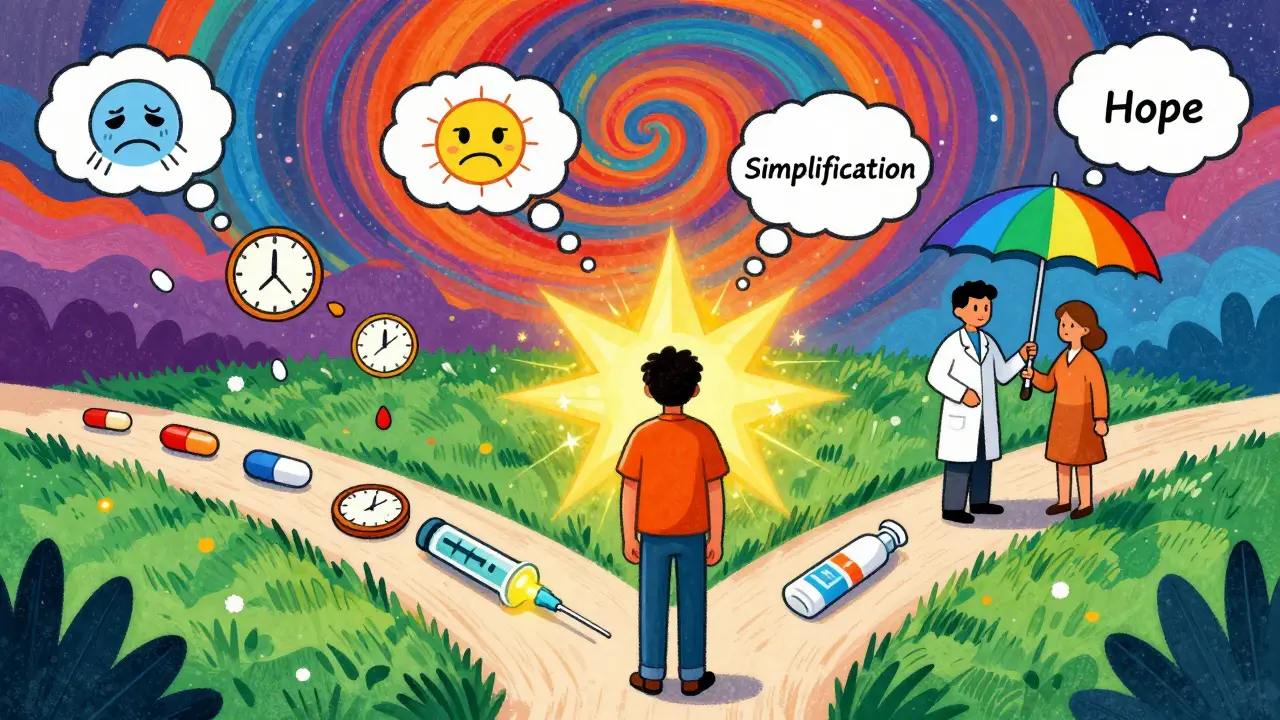
It’s not rare to hear someone say, "I forgot to take my pill." But for people managing serious mental health conditions like schizophrenia, bipolar disorder, or severe depression, forgetting a dose isn’t just a slip-up-it can mean a hospital trip, a relapse, or worse. Around 40% to 60% of people with psychiatric conditions don’t take their meds as prescribed. That’s not because they’re lazy or irresponsible. It’s because the system isn’t built to help them succeed.
The numbers are brutal. In the U.S., non-adherence contributes to up to 25% of all hospitalizations. The CDC estimates it’s linked to 125,000 deaths every year. And yet, this problem flies under the radar. It’s called an "invisible epidemic" for a reason: no one talks about it, and few systems are designed to fix it.
Why Do People Stop Taking Their Medication?
It’s easy to blame patients, but the real reasons are deeper. A 2024 study in the Journal of Psychiatric Research found that the biggest predictors of non-adherence aren’t forgetfulness-they’re feelings. People stop taking meds because they feel worthless. Because they believe the drugs are making them numb. Because they’ve been told their illness isn’t "real"-or because their doctor never explained why the pill matters.
For elderly patients with depression, the chance of sticking to meds drops by 40%. For homeless individuals with schizophrenia, adherence rates fall as low as 26%. And it’s not just about money-even people with insurance often can’t access care because of long wait times, confusing prescriptions, or fear of side effects.
One major factor? Dosing complexity. If you have to take three pills at three different times a day, your brain gets overwhelmed. A NAMI survey found that 87% of people stuck to their meds when they were on once-daily dosing. Only 52% did when it was multiple times a day. Yet 73% of patients said their provider never even asked if simplifying the regimen was possible.
What Actually Works? The Evidence
Not all interventions are created equal. Some apps, reminders, or pamphlets do little. But a few approaches have moved the needle-dramatically.
Pharmacist-led care is the standout. In a 2025 Frontiers in Psychiatry trial, patients working with a pharmacist and psychiatrist together saw a 142% greater improvement in adherence than those getting standard care. Pharmacists don’t just hand out pills-they explain why the drug works, check in on side effects, and adjust doses with the doctor. One program in Kaiser Permanente’s Northern California region boosted adherence by 32.7% in just 90 days. Hospitalizations dropped by 18.3%.
Why does this work? Because pharmacists spend time. They ask: "Do you feel worse after taking this?" "Are you scared of gaining weight?" "Can you afford this?" They don’t treat adherence like a compliance issue-they treat it like a human one.
Another powerful tool? Long-acting injectables. The FDA’s 2024 guidance pointed to data showing 87% adherence with monthly injections versus just 56% for daily pills. For someone who struggles with memory, routine, or stigma, a shot every four weeks is life-changing. It’s not a cure-but it removes the daily battle.
And then there’s simplicity. Reducing the number of pills. Combining meds into one tablet. Switching from three-times-daily to once-daily. A 2023 study found that when regimens were simplified, adherence jumped from 52% to 87%. Yet most providers still don’t ask.

The Hidden Barriers: Cost, Shame, and Fragmented Care
Money is a huge factor. A single antipsychotic can cost $500 a month without insurance. Even with coverage, copays can be $100+. A Reddit thread from March 2025 with over 1,200 responses showed that 78% of users improved adherence when they worked with a medication specialist-but 64% said insurance blocked access to those services.
Stigma plays a role too. People don’t want to be seen picking up psychiatric meds. Some hide pills in their socks. Others take them only when someone’s watching. One woman in Sydney told her doctor she was "non-adherent" because she didn’t want her neighbors to know she was on mood stabilizers.
And then there’s the system itself. Psychiatrists, GPs, pharmacists, case managers-they rarely talk to each other. A patient might get a new script from one doctor, a refill reminder from a pharmacy, and a follow-up call from a nurse-all without coordination. No one owns the problem. So it falls through the cracks.
What’s Working Right Now? Real Examples
Some health systems are fixing this. In San Diego, a program that paired homeless patients with a pharmacist and a social worker increased adherence from 26% to 61% in six months. They didn’t just hand out pills-they helped with housing, transportation, and ID paperwork.
Kaiser Permanente’s Medication Regimen Management (MRM) program trained pharmacists to review every psychiatric patient’s full med list, flag interactions, and simplify dosing. The result? A 32.7% adherence boost and a CMS Star Rating jump from 3.8 to 4.3.
Even tech is helping-not with flashy apps, but with smart alerts. A 2025 Nature Mental Health study used smartphone data (typing speed, location changes, call patterns) to predict when someone was likely to miss a dose-82.4% accuracy, 72 hours in advance. That’s not surveillance. It’s intervention. Clinics using this tool now reach out before the lapse happens.

What Needs to Change
Here’s the hard truth: no app, reminder, or poster will fix this unless we change how care is delivered.
- Make dosing simple. If a patient is on three pills a day, ask: "Can we combine them?"
- Include pharmacists in care teams. They’re not just dispensers-they’re mental health allies.
- Address cost upfront. Ask: "Can you afford this?" Then help find alternatives, coupons, or patient assistance programs.
- Use long-acting injectables when appropriate. They’re not a last resort-they’re a first-line option for many.
- Train providers to talk about feelings, not just numbers. Ask: "What’s the hardest part about taking this?" Not: "Why aren’t you taking it?"
Health systems are starting to pay for this. CMS now ties 7 of its 13 Medicare Advantage quality measures to adherence. UnitedHealthcare’s 2025 contracts tie 12% of provider pay to meeting 80% adherence targets. That’s a start. But real change needs more than incentives-it needs redesign.
What You Can Do
If you’re a patient: Ask your provider if your regimen can be simplified. Ask if a long-acting injection is an option. Ask if a pharmacist can help you manage your meds. You’re not being difficult-you’re advocating for your health.
If you’re a caregiver: Notice if someone stops taking meds. Don’t assume they’re giving up. Ask what’s getting in the way. Is it cost? Side effects? Shame? Help them find a pharmacist or support group.
If you’re a clinician: Stop assuming adherence is about willpower. Start asking about lived experience. Track adherence like you track blood pressure. Involve pharmacists. Simplify regimens. And remember: 80% adherence isn’t a target-it’s a minimum.
The invisible epidemic isn’t going away. But it can be addressed-with better systems, better care, and better conversations. Not with more pills. With more humanity.
Why is medication non-adherence so common in mental health compared to other chronic conditions?
Unlike diabetes or hypertension, mental health conditions often affect a person’s insight into their illness. Someone with high blood pressure can feel the consequences-headaches, dizziness-but someone with schizophrenia may not believe they’re ill. This lack of insight, called anosognosia, is a biological symptom, not defiance. Also, side effects like weight gain, fatigue, or emotional numbness are uniquely distressing and poorly managed in routine care. Unlike other conditions, mental health care is often fragmented across specialists, with no one overseeing the full picture.
Can digital apps help with medication adherence for mental health?
Basic reminder apps have minimal impact-studies show only a 1.8% to 2% improvement. But smarter tools are emerging. AI systems that analyze smartphone behavior-like changes in typing speed, social interaction, or location patterns-can predict a lapse 72 hours in advance with 82% accuracy. These aren’t push notifications; they’re early-warning systems that trigger human outreach. The best digital tools are those that connect to a real person, not just a phone.
Are long-acting injectables better than daily pills?
For many, yes. A 2023 JAMA Psychiatry study found 87% adherence with monthly injections versus 56% with daily pills. That’s not because injections are more effective-it’s because they remove the daily decision. For someone with memory issues, depression, or stigma, one shot a month is easier than remembering three pills a day. They’re especially helpful for people with schizophrenia or bipolar disorder who’ve had multiple relapses. They’re not a "last resort"-they’re a practical tool.
Why don’t more doctors simplify medication regimens?
Time and training. Most psychiatric visits last 15-20 minutes. Doctors are focused on symptoms, not logistics. They may not know which meds can be combined or switched to once-daily versions. A 2024 survey found that 73% of patients never had this conversation. Pharmacists, however, are trained to do this exact work. When they’re part of the team, simplification happens automatically.
What’s the role of cost in non-adherence?
Cost is a major barrier-even for people with insurance. A single antipsychotic can cost $500/month out-of-pocket. A 2025 Reddit survey of 1,247 users showed that 64% couldn’t access pharmacist-led care because their insurance wouldn’t cover it. Programs that offer copay assistance, generic alternatives, or patient assistance programs can double adherence. But most clinics don’t have staff trained to navigate these systems.