
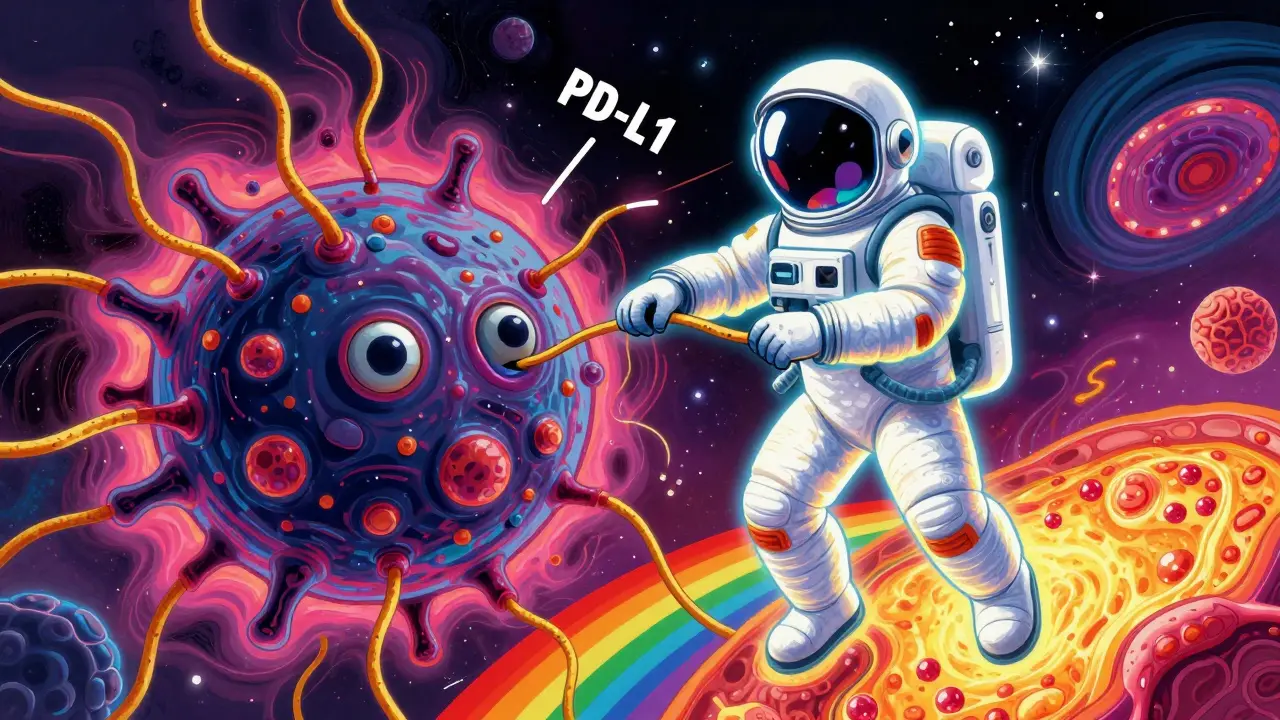
When your body’s immune system fails to stop cancer, science has built a new way to help it fight back. Two breakthroughs-checkpoint inhibitors and CAR-T cell therapy-are changing how we treat some of the toughest cancers. They don’t kill tumors directly. Instead, they give your own immune cells the tools and freedom to do the job. But they work in completely different ways, have different risks, and work better for some cancers than others.
How Checkpoint Inhibitors Unleash the Immune System
Your immune system has built-in brakes to keep it from attacking healthy tissue. Cancer cells exploit these brakes. They put up signals-like PD-L1-that tell T cells, "Don’t attack me." Checkpoint inhibitors are lab-made antibodies that block those signals. Think of them as cutting the wires on a hidden alarm system cancer uses to hide.
The first one, ipilimumab, hit the market in 2011 for advanced melanoma. It blocked CTLA-4, one of those immune brakes. Soon after, drugs like pembrolizumab and nivolumab came out, targeting PD-1. These drugs helped some patients live years longer-even when nothing else worked. Today, they’re used for lung cancer, kidney cancer, Hodgkin lymphoma, and more.
But here’s the catch: only 20 to 40% of patients respond. Why? Because many tumors don’t have enough immune cells inside them to begin with. If your body doesn’t have T cells near the tumor, blocking the brake won’t help. That’s where CAR-T therapy comes in.
What CAR-T Therapy Is-and How It’s Made
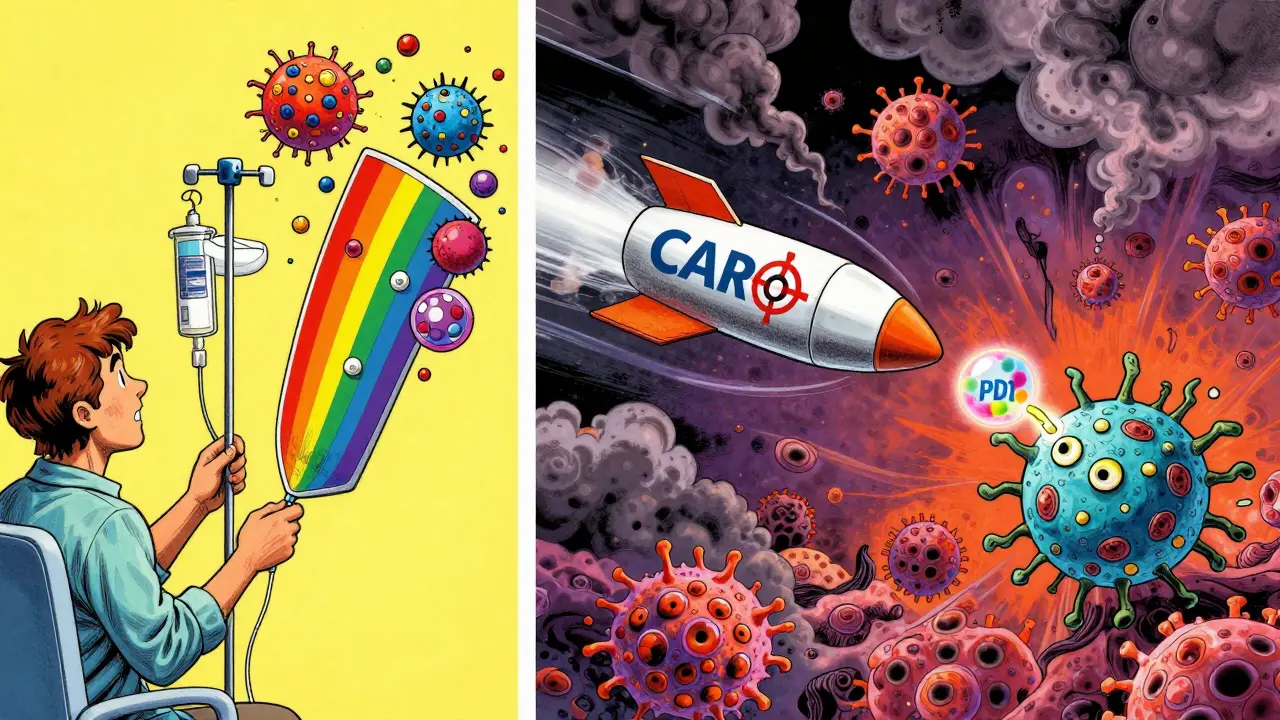
CAR-T therapy is like giving your immune system a custom-made missile. Doctors take T cells from your blood, then in a lab, they add a synthetic receptor called a chimeric antigen receptor (CAR). This receptor is designed to lock onto a specific protein on cancer cells-like CD19 on B-cell leukemia.
The process takes 3 to 5 weeks. First, you get a procedure called leukapheresis, where blood is drawn and T cells are pulled out. Then, those cells are genetically modified using viruses to carry the CAR gene. After they multiply in bioreactors, they’re frozen, shipped back, and infused into you. Before the infusion, you get chemotherapy to clear space for the new cells.
The results? In kids with relapsed acute lymphoblastic leukemia (ALL), complete response rates hit 60 to 90%. For certain types of lymphoma, many patients stay in remission for years. The first CAR-T therapy, tisagenlecleucel, was approved in 2017. Since then, others like axicabtagene ciloleucel and lisocabtagene maraleucel have followed.
Why CAR-T Struggles With Solid Tumors
For blood cancers, CAR-T works like a charm. For solid tumors-like lung, breast, or colon cancer-it’s a different story. Most trials show less than 10% response rates. Why?
- Target proteins on solid tumors aren’t as unique. They often appear on healthy tissue too, raising the risk of dangerous side effects.
- The tumor environment is hostile. It’s filled with cells and chemicals that shut down T cells.
- It’s hard for CAR-T cells to get inside the tumor. They get stuck at the edges.
One big problem is the immunosuppressive microenvironment. Tumors create a zone where immune cells can’t function. They produce signals that exhaust T cells, block their movement, or even turn them into helpers for the cancer.
That’s why researchers are trying to engineer smarter CAR-T cells. Some now carry genes that secrete IL-12 to wake up other immune cells. Others are built to resist exhaustion signals like PD-1. One 2018 study showed CAR-T cells engineered to release their own PD-1-blocking antibody reduced side effects by 37% while still killing tumors in mice.
Side Effects: What You Need to Know
Both therapies can cause serious side effects-but they’re different.
Checkpoint inhibitors often trigger immune-related adverse events (irAEs). These happen because the immune system, now unblocked, starts attacking healthy organs. Common ones include:
- Rash or itchy skin (30-40% of patients)
- Colitis (inflammation of the colon, 10-15%)
- Thyroid problems (hypothyroidism in 5-10%)
- Pneumonitis (lung inflammation, up to 5%)
These are usually manageable with steroids-but if missed, they can be life-threatening.
CAR-T therapy brings its own dangers. About 50-70% of patients get cytokine release syndrome (CRS). This is an overwhelming immune reaction that causes high fever, low blood pressure, and trouble breathing. Around 20-40% develop immune effector cell-associated neurotoxicity syndrome (ICANS), which can lead to confusion, seizures, or trouble speaking. Both require ICU-level care.
And here’s something few talk about: the risk of "on-target, off-tumor" toxicity. If the CAR targets a protein also found on normal cells-like CD19 on healthy B cells-you lose those cells too. Patients need lifelong immunoglobulin replacement. That’s a trade-off.
Combining the Two: The Future of Treatment
The smartest move might be using both together. Checkpoint inhibitors can help CAR-T cells last longer and work better inside tumors. CAR-T cells can bring immune cells into solid tumors, where checkpoint inhibitors can then activate them.
As of 2024, over 47 clinical trials are testing this combo-68% of them focused on solid tumors. Early results are promising. One approach, called "armored CAR-T," adds genes that let the cells secrete checkpoint-blocking antibodies right at the tumor site. This avoids the toxic side effects of giving the drug systemically. In animal studies, this cut immune pneumonitis by 42%.
Scientists are also looking at new checkpoints beyond PD-1 and CTLA-4-like LAG-3 and TIM-3. One study found blocking PTP1B, an internal checkpoint inside T cells, boosted tumor-killing by 2.3 times in breast cancer models.
Access, Cost, and Real-World Barriers
These aren’t just medical breakthroughs-they’re expensive and hard to get.
CAR-T therapy costs between $373,000 and $475,000 per treatment. The manufacturing process is slow, complex, and only available at a few hundred specialized centers. In the U.S., 87% of CAR-T treatments happen at academic hospitals, even though they make up only 15% of cancer centers.
Access isn’t equal. A 2020 review found Black patients were 31% less likely to get CAR-T than White patients. Medicaid patients were 23% less likely to receive checkpoint inhibitors. Insurance coverage, geographic location, and hospital resources create real gaps in care.
Checkpoint inhibitors are "off-the-shelf"-any hospital can give them. But even they require expertise to manage side effects. Many community clinics don’t have the staff trained to handle immune-related complications.
What’s Next?
The future is about making these therapies work for more people, faster, and safer.
- "Off-the-shelf" CAR-T: Using donor T cells instead of your own. This cuts wait time from weeks to days.
- Targeting new antigens: Finding proteins unique to tumors but not healthy tissue.
- Combination therapies: Pairing CAR-T with drugs that break down the tumor’s defenses.
- Biomarkers: Using blood tests or scans to predict who will respond before treatment even starts.
One thing is clear: immunotherapy isn’t a magic bullet. But for patients who’ve run out of options, it’s the best shot they’ve had in decades. The goal now isn’t just to make these therapies work-but to make them work for everyone.
Are checkpoint inhibitors and CAR-T therapy the same thing?
No. Checkpoint inhibitors are IV drugs that remove signals cancer uses to hide from your immune system. CAR-T therapy is a personalized treatment where your own T cells are removed, genetically changed to target cancer, and put back into your body. One is a drug; the other is a living therapy.
Which cancers respond best to CAR-T therapy?
CAR-T works best in certain blood cancers: B-cell acute lymphoblastic leukemia (ALL) in children and young adults, and certain types of non-Hodgkin lymphoma like diffuse large B-cell lymphoma. It has limited success in solid tumors like lung, breast, or colon cancer so far.
Why is CAR-T therapy so expensive?
Each CAR-T treatment is custom-made for one patient. It requires collecting your T cells, shipping them to a lab, genetically modifying them, growing them in large quantities, testing them for safety, and shipping them back-all under strict controls. This complex, one-at-a-time process drives the cost to $400,000 or more.
Can you get CAR-T therapy more than once?
It’s possible, but rare. Many patients who relapse after CAR-T still have the target protein on their cancer cells. But their T cells may be too damaged from the first treatment, or the cancer may have changed its targets. Newer CAR-T versions are being tested for repeat use, but it’s not standard yet.
Do checkpoint inhibitors work for everyone?
No. Only about 20-40% of patients respond, depending on the cancer type. Factors like tumor mutation load, PD-L1 levels, and whether immune cells are already present in the tumor affect response. Some cancers, like pancreatic or glioblastoma, rarely respond at all.
What’s the biggest risk with combining CAR-T and checkpoint inhibitors?
The biggest risk is worsening side effects. Both therapies can cause severe inflammation. When used together, the chance of life-threatening cytokine release syndrome or neurotoxicity increases. That’s why researchers are testing ways to deliver checkpoint blockers only inside the tumor-using CAR-T cells that make their own antibodies locally-to avoid flooding the whole body with immune-stimulating drugs.
Praseetha Pn
January 18, 2026 AT 10:28So let me get this straight - we’re genetically engineering human cells to hunt down cancer, but the pharma giants are charging half a million bucks for it? And you think that’s science? Nah, that’s capitalism with a lab coat. I’ve seen patients in Mumbai die because their insurance won’t cover the ‘living therapy’ while some CEO in Boston buys a third yacht. This isn’t medicine - it’s a luxury auction.
Dayanara Villafuerte
January 18, 2026 AT 19:53Y’all are acting like CAR-T is magic 🤡 But honestly? It’s like giving someone a Ferrari and then telling them to drive it through a minefield. The science is wild, sure - but the side effects? CRS feels like your body’s having a rave while your brain’s getting hacked. And don’t even get me started on the ‘on-target, off-tumor’ mess. You’re saving their life… by making them permanently immunocompromised. 😅
Kristin Dailey
January 20, 2026 AT 19:28USA leads in this tech. Other countries are just trying to copy it. We built this. Stop complaining about cost - innovation isn’t free.
Robert Cassidy
January 22, 2026 AT 15:39They’re not telling you the whole story. Checkpoint inhibitors? They were developed with DARPA funding. CAR-T? Patent-controlled by three biotech conglomerates. The ‘breakthrough’ narrative? A distraction. The real goal isn’t curing cancer - it’s creating lifelong dependency. You think they want you cured? No. They want you on maintenance for 20 years. Watch the stock prices. They spike every time a new trial fails. Coincidence? I think not.
Jodi Harding
January 24, 2026 AT 05:25It’s not about whether it works. It’s about who gets to live.
Tyler Myers
January 25, 2026 AT 15:09Why are we letting corporations decide who gets to live? My cousin had melanoma. They gave him pembrolizumab. He lived 5 years. Then they stopped covering it. He died. That’s not healthcare. That’s a lottery rigged by insurance CEOs. We need universal access - or we’re not better than the 1800s.
Ryan Otto
January 25, 2026 AT 20:52While the public fixates on cost and access, the real crisis lies in the epistemological collapse of oncology. The reductionist paradigm - targeting single antigens, assuming linear immune response - is fundamentally flawed. CAR-T’s failure in solid tumors is not logistical; it is ontological. The tumor microenvironment is a dynamic, adaptive system. To treat it as a static target is to misunderstand life itself. We are not engineering cells - we are playing god with a broken blueprint. The data is not in the genes; it is in the chaos.
And yet, we celebrate ‘breakthroughs’ while ignoring the fact that 60% of responders relapse within 18 months. The placebo effect of hope is now the primary therapeutic agent. We have replaced medicine with mythology dressed in CRISPR.
Even the so-called ‘armored CAR-T’ - a grotesque fusion of genetic engineering and immunomodulation - merely layers complexity atop failure. The PD-1-blocking CAR-T cells? They’re not solving the problem. They’re just adding another variable to an already unstable equation. The real breakthrough would be admitting we don’t understand the system we’re manipulating.
And let’s not pretend the disparities in access are accidental. They are the inevitable product of a system that commodifies biology. The same system that patented the BRCA gene now patents T-cell receptors. This isn’t innovation - it’s bio-feudalism.
Meanwhile, the NIH pours billions into ‘next-gen’ therapies while primary care in rural America collapses. We are building golden cages for the elite while the rest of the world drowns in the tide of preventable disease. The cure for cancer is not in a lab. It is in equity. In dignity. In a world that values life over profit. But that’s too radical for the conference halls.
Zoe Brooks
January 26, 2026 AT 14:29I just want to say - if you or someone you love has ever been told ‘there’s nothing else we can do’… and then got a second chance? This is worth every penny, every wait, every scary side effect. I’ve seen it. I’ve lived it. It’s not perfect. But it’s hope. And sometimes? Hope is the only thing that keeps you breathing. ❤️