

When a child can’t swallow a pill, or needs a medicine without certain ingredients like sugar, dye, or alcohol, compounded medications can be a lifeline. These aren’t mass-produced drugs you find at your local pharmacy. They’re custom-made by licensed pharmacists to fit a child’s exact needs - whether that’s a tiny dose of a heart medication, a flavored liquid for a picky toddler, or a preservative-free injection for a newborn. But here’s the hard truth: compounded medications for children come with real, preventable risks. And too often, parents aren’t warned about them.
Unlike FDA-approved drugs, compounded medications aren’t tested for safety or effectiveness before they’re given to kids. The FDA doesn’t approve them. That means there’s no guarantee the dose is right, the flavor won’t cause a reaction, or the liquid didn’t get contaminated during mixing. In fact, the Institute for Safe Medication Practices found that 14% to 31% of pediatric medication errors involve compounded drugs - mostly because of wrong dosing or unclear instructions.
Why Compounded Medications Are Used for Kids
Not every child can take a standard pill. Some are too young. Others have allergies. Some need a dose so small it’s impossible to split a tablet accurately. That’s where compounding comes in. Common reasons include:
- Children who can’t swallow pills and need liquid forms
- Need for dye-free or alcohol-free formulas due to sensitivities
- Flavoring bitter medicines (like antibiotics or thyroid pills) to improve acceptance
- Sugar-free versions for diabetic children
- Preservative-free injectables for newborns (to avoid toxic chemicals like benzyl alcohol)
- Diluting adult-strength medications into tiny, precise doses for infants
These aren’t just convenient - they’re often essential. A baby in the NICU might need a fraction of a milligram of morphine. An 8-year-old with hypothyroidism might need a custom dose of levothyroxine that’s not available in stores. But these customizations open the door to serious mistakes.
The Hidden Dangers
The biggest danger? Dosing errors. Children aren’t small adults. A tiny mistake in concentration - like confusing milligrams per milliliter with micrograms per milliliter - can be deadly. One parent on Reddit shared that their 8-year-old ended up in the ER after a compounded levothyroxine dose was 40% weaker than prescribed. The child developed hypothyroid symptoms: fatigue, weight gain, and cold intolerance. The pharmacy didn’t label the concentration clearly. The doctor didn’t double-check. And the parent didn’t know to ask.
Contamination is another silent threat. Back in 2012, a fungal meningitis outbreak killed 64 people and sickened nearly 800 after contaminated compounded spinal injections were given. That was a single pharmacy. Today, over 7,200 compounding pharmacies operate in the U.S. - but only about 1,400 are accredited by the Pharmacy Compounding Accreditation Board (PCAB). That means most aren’t held to the same hygiene and quality standards.
Even more alarming: the FDA has documented over 900 adverse events linked to compounded semaglutide and tirzepatide by the end of 2024 - including 17 deaths. While these drugs are often used for adults, children with rare conditions like severe obesity or endocrine disorders are sometimes prescribed them off-label. And when the concentration is off? Kids suffer severe vomiting, dehydration, pancreatitis, and even organ damage.
What Makes a Compounding Pharmacy Safe?
Not all pharmacies are created equal. If you’re being told your child needs a compounded medication, ask these questions:
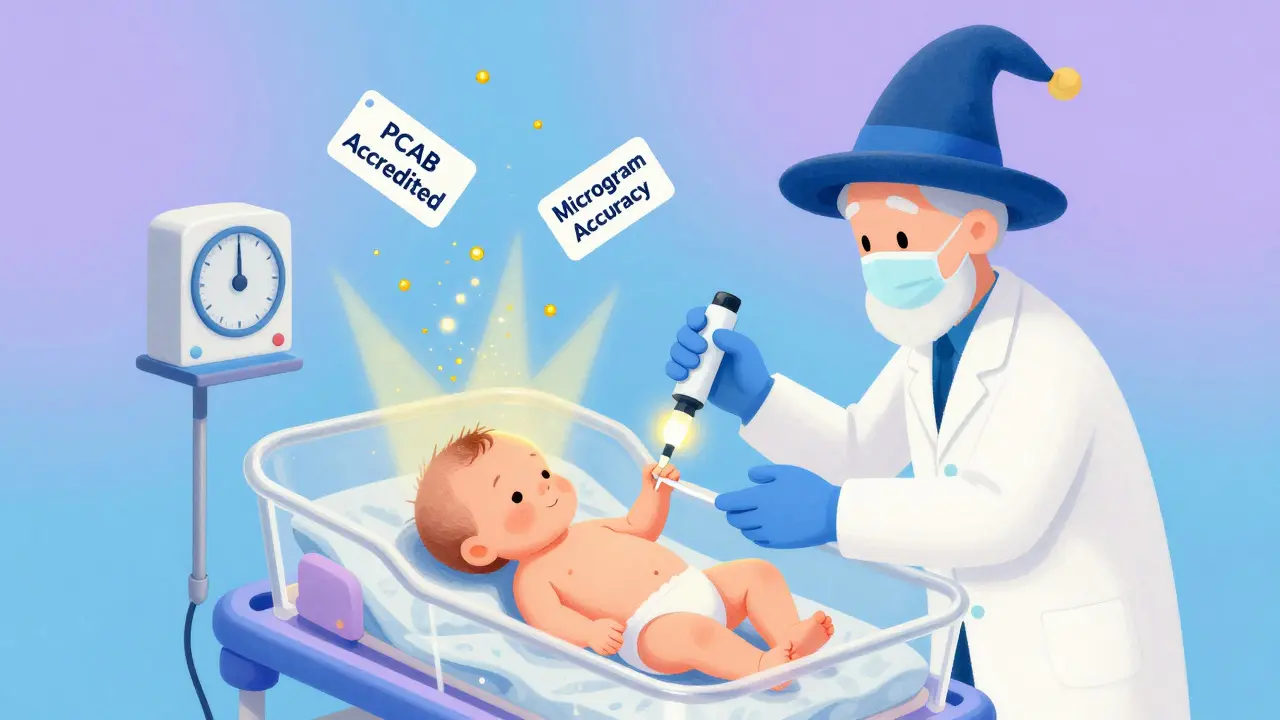
- Are they accredited? Look for PCAB or NABP accreditation. These are voluntary but show the pharmacy meets national safety standards. You can check their status at nabp.pharmacy.
- Do they use gravimetric analysis? This is a high-tech weighing system that measures ingredients to the microgram. It’s far more accurate than measuring by volume. Only 7.7% of U.S. hospitals use it - mostly because it costs $25,000 to $50,000 per station. But pharmacies that do use it cut pediatric dosing errors by 75%.
- Do they do double-checks? For sterile preparations (like injections or IVs), trained technicians should independently verify each dose. This is required under USP Chapter <797>, but not all pharmacies follow it.
- Are they licensed by the state? Every compounding pharmacy must be licensed by its state board of pharmacy. Ask for the license number and verify it online.
Don’t be shy. You’re your child’s best advocate. If a pharmacist seems annoyed by your questions, walk away.
How Parents Can Prevent Mistakes
Here’s what you need to do - step by step - before giving your child a compounded medication:
- Ask for the exact concentration. Never accept a bottle that says “10 mg/mL” without knowing if it’s milligrams or micrograms. Write it down. Say it out loud: “So this is 10 milligrams per milliliter?” Confirm with the pharmacist.
- Double-check the dose with the doctor. Ask your pediatrician: “Is this the right dose for my child’s weight?” Even if the prescription says 0.5 mL, calculate it yourself. For example: If the concentration is 10 mg/mL and your child needs 2 mg, they need 0.2 mL - not 0.5 mL. A simple math error can be fatal.
- Use the right syringe. Always use a calibrated oral syringe (not a teaspoon or kitchen spoon). Oral syringes come in 1 mL, 3 mL, and 5 mL sizes. Make sure the markings are clear and easy to read.
- Store it properly. Some compounded meds need refrigeration. Others must be used within 7 days. Ask for written storage instructions. If the liquid changes color or smells odd - don’t use it.
- Keep a log. Write down the date, time, dose, and how your child reacted. This helps spot patterns if side effects show up later.
According to SafeMedicationUse.ca, 68% of pediatric compounding errors happen because of unclear communication about concentration. That’s not the pharmacist’s fault alone - it’s a system failure. But you can break that chain.
When Not to Use a Compounded Drug
The FDA is clear: compounded medications should only be used when no FDA-approved alternative exists. If there’s a commercially available liquid version of a drug - even if it’s more expensive - use that instead. Why? Because those drugs are tested. They’re consistent. They’re labeled clearly.
For example: If your child needs amoxicillin, there are FDA-approved flavored suspensions on the market. You don’t need a compounded version unless they’re allergic to the flavoring or preservatives in those. Same with thyroid medication - if a commercial tablet can be crushed and mixed into food, do that. Compounding should be a last resort, not the first choice.
The Bigger Picture
There’s a growing trend: pharmacies are using drug shortages as an excuse to mass-produce compounded versions of popular drugs - even after the shortage ends. This isn’t what compounding was meant for. It was designed for unique patient needs, not to replace FDA-approved products on a large scale.
And yet, the market for compounded drugs hit $11.3 billion in 2024, growing at over 12% per year. Pediatric use makes up only 8.2% of that - but it’s where the most serious errors happen. Why? Because kids are small. Their bodies are fragile. And a 10% error in a 500 mg adult dose might be harmless. In a 5 mg infant dose? It’s a life-threatening overdose.
Organizations like the Emily Jerry Foundation are pushing for laws - called “Emily’s Law” - that would require gravimetric analysis for all pediatric sterile compounding. So far, 28 states have introduced such bills. But until these rules become nationwide, the burden falls on parents.
Final Advice: Trust, But Verify
You can’t avoid compounded medications entirely if your child needs them. But you can protect them. Always:
- Ask for accreditation
- Confirm the concentration
- Verify the math with your doctor
- Use a proper syringe
- Watch for side effects
If something feels off - the taste is strange, the color changed, your child seems unusually sleepy or sick - call your pharmacist and your pediatrician immediately. Don’t wait. Don’t assume it’s fine. These drugs aren’t regulated like the ones in the big boxes at CVS. They’re made in small batches, by hand. And that’s where the risk lives.
Compounding isn’t evil. It’s necessary. But it’s not safe by default. Safety comes from knowledge, questions, and vigilance. And as a parent, you’re the last line of defense.
MALYN RICABLANCA
March 18, 2026 AT 22:58OMG. I just read this and I’m SHAKING. My daughter had a compounded thyroid med last year - and the pharmacist wrote ‘0.5 mg/mL’… but it was actually 0.5 mcg/mL. We didn’t catch it until she started sleeping 16 hours a day. I almost lost her. I called the FDA. I called the state board. I called every news outlet. And guess what? NOTHING HAPPENED. They just said ‘oops.’
These pharmacies are running wild. No oversight. No accountability. And parents? We’re left holding the bag while our kids pay the price.
Why isn’t this a national emergency? Why aren’t we shutting down non-PCAB pharmacies TODAY? I’m not just angry - I’m terrified. And I’m not alone.
gemeika hernandez
March 19, 2026 AT 04:28This is so scary. I didn’t know any of this. My kid got a compounded antibiotic and I just gave it like normal. Now I’m scared to give her anything that’s not in a bottle from CVS.
Nicole Blain
March 20, 2026 AT 11:34Yikes. 🤢 I’m glad I read this before my son’s next prescription. I’ll be asking ALL the questions now. Gravimetric? PCAB? Double-checks? I’m writing them on my hand. 👏
Kathy Underhill
March 21, 2026 AT 00:42The core issue isn’t compounding. It’s the abandonment of systemic safeguards. When we outsource critical care to unregulated entities, we normalize risk. The burden shouldn’t fall on parents to become pharmacologists. Regulation must evolve - not just for profit, but for survival.
Stephen Habegger
March 22, 2026 AT 17:33Good read. I’m sharing this with my pediatrician. We need more awareness - not fear. Knowledge saves lives.
lawanna major
March 24, 2026 AT 07:22Every parent deserves to know the difference between a compounded medication and a mass-produced one. This article doesn’t just inform - it empowers. The five-step checklist alone could prevent countless tragedies. Thank you for writing this with such clarity and urgency.
Ryan Voeltner
March 25, 2026 AT 12:40While the concerns raised are valid and deeply concerning, it is imperative that we approach this issue with measured diligence rather than alarmism. The pharmaceutical landscape is complex, and while regulatory gaps exist, many compounding pharmacies operate with exceptional integrity and precision. The solution lies not in blanket suspicion but in structured oversight, accreditation enforcement, and collaborative education between clinicians, pharmacists, and caregivers.
Linda Olsson
March 27, 2026 AT 10:15Of course the FDA doesn’t regulate these. They’re in bed with Big Pharma. Why would they want you to use cheap, safe, FDA-approved drugs when they can make billions off shady compounding labs? This is all about profit. They let kids get sick so they can sell you more drugs later. Wake up.
Melissa Starks
March 29, 2026 AT 06:41Okay so I’m a nurse and I’ve seen this firsthand. We had a baby in NICU once - 2.3 kg - got a compounded vancomycin. The concentration was labeled as ‘10 mg/mL’ but the vial had a sticker underneath that said ‘10 mcg/mL’ - no one caught it. The baby went into cardiac arrest. We saved her. But her kidneys are permanently damaged. I’ve been screaming about this for years. No one listens. But I’m not done. Parents - you have to demand the lab report. You have to ask for the formula. You have to write down the numbers. If they roll their eyes - leave. Don’t wait. Don’t hope. Act. I’m not being dramatic. I’m telling you what I’ve seen. Your child is worth it.
Lauren Volpi
March 30, 2026 AT 16:32Why are we even letting this happen? We’re a first-world country. We have 3D printers and AI. But we let some guy in a basement pharmacy mix up kids’ meds with a measuring cup? This is insane. Just make real pediatric doses. Stop being lazy.
Suchi G.
March 31, 2026 AT 19:39I live in India and we use compounded medicines all the time because branded drugs are too expensive. My son had asthma and we used a compounded albuterol suspension - it worked. But I didn’t know about PCAB or gravimetric analysis. I just trusted the pharmacist. Now I’m terrified. I don’t know if I made the right choice. I wish someone had told me this earlier. I feel guilty. But I also feel like I did the best I could with what I knew. Maybe the system should protect us - not make us feel like criminals for trying to save our kids.
becca roberts
April 2, 2026 AT 08:40So… you’re telling me the same pharmacy that made my kid’s strawberry-flavored amoxicillin also made the 17 dead kids’ semaglutide? 😏 How many other ‘convenient’ meds are just time bombs? I’m not mad - I’m fascinated. And honestly? Kinda impressed. The audacity.
Andrew Muchmore
April 3, 2026 AT 07:40Accreditation matters. Gravimetric analysis isn’t optional - it’s basic science. If your pharmacy doesn’t use it, they’re not qualified. Period. Ask for proof. If they hesitate - walk out. Your child’s life isn’t a gamble.