
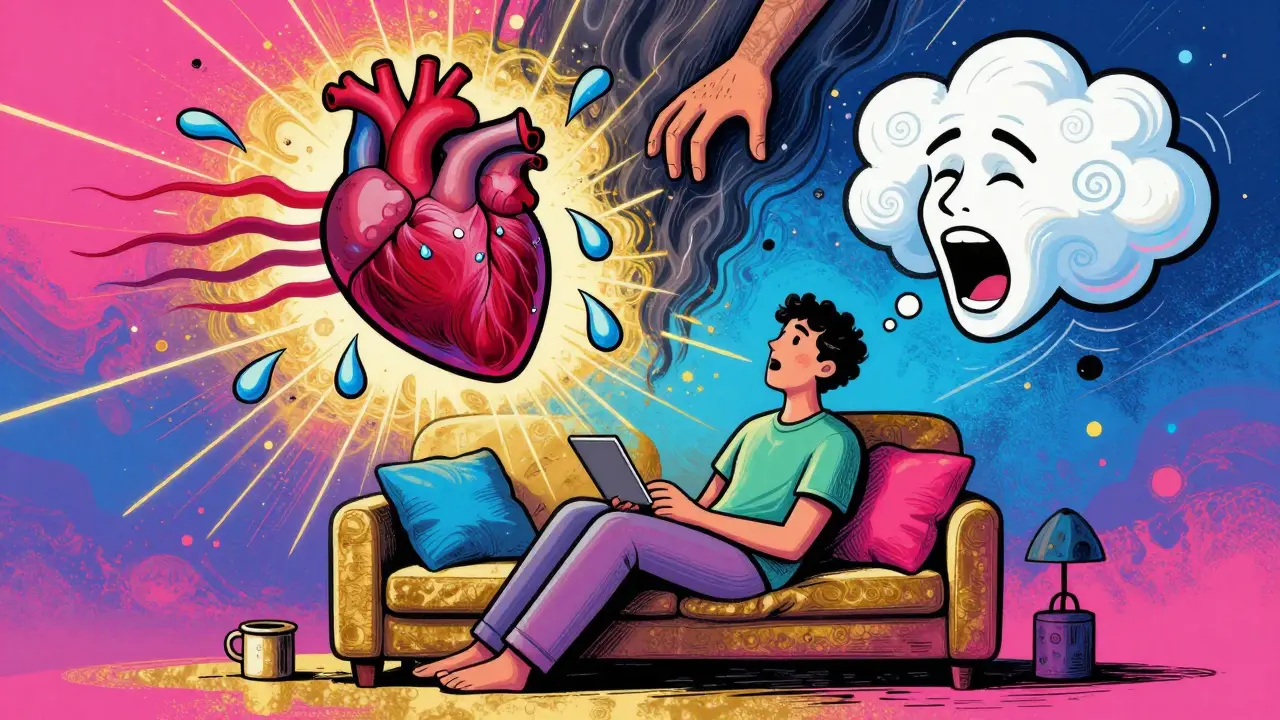
When your heart races out of nowhere, your chest tightens, and you feel like you’re dying-yet you’re sitting quietly at home-you’re not having a heart attack. You’re having a panic attack. And if this happens repeatedly, without warning, it’s not just stress. It’s panic disorder.
Panic disorder isn’t about being nervous before a presentation or feeling jittery on a plane. It’s when your body sounds a false alarm so often that you start living in fear of the next one. About 4.7% of U.S. adults will experience this in their lifetime, with women twice as likely to be affected as men. Most people first notice symptoms in their late teens or early 20s. By age 35, three out of four people with panic disorder have already had their first attack.
What Happens During a Panic Attack?
A panic attack hits fast. Within minutes, your body goes into full survival mode-even when there’s no real danger. Your heart slams against your ribs at over 120 beats per minute. You can’t catch your breath. Your hands go numb. You feel like you’re choking, or that the room is spinning, or that you’re losing control-or worse, that you’re about to die.
The DSM-5-TR lists 13 possible symptoms. You need at least four to qualify as a panic attack. The most common ones? Palpitations (felt by 98% of people), sweating (75%), trembling (72%), shortness of breath (59%), chest pain (68%), and fear of dying (80%). These aren’t imaginary. Your sympathetic nervous system is firing like a wildfire. Your adrenaline spikes. Your muscles tense. Blood rushes away from your skin and toward your limbs-your body’s ancient response to a predator.
Most attacks last between 5 and 20 minutes. But because the fear feels so real, they can feel like hours. Afterward, you’re exhausted. And then comes the worst part: waiting for the next one.
Agoraphobia: The Invisible Prison
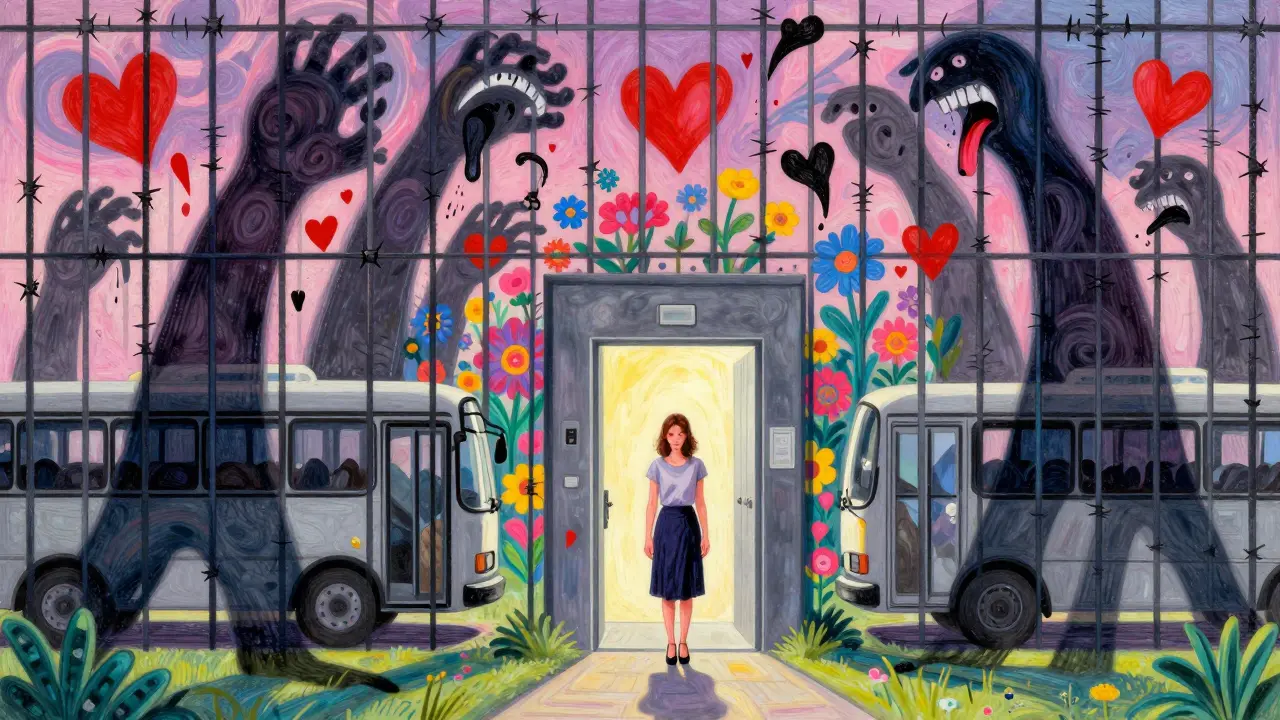
After a few panic attacks, your brain starts making connections. That attack happened on the bus. That one happened in the grocery store. That one happened when I was alone. Soon, you’re not afraid of the attack-you’re afraid of the places where it might happen again.
This is agoraphobia. It’s not just fear of open spaces. It’s fear of being trapped, helpless, or far from help. For many, it means avoiding public transportation (62% of cases), crowded places (59%), enclosed spaces like elevators (48%), or even leaving the house alone (72%). Some people become housebound for years. One Reddit user shared that after her first attack at 22, she avoided buses for three years. Another said she hadn’t left her home in four months.
Agoraphobia doesn’t make you lazy or weak. It’s a survival tactic gone wrong. Your brain thinks: If I don’t go to the mall, I won’t have an attack. If I don’t drive, I won’t crash. If I stay home, I’m safe. But the truth? Staying home doesn’t stop panic. It just teaches your brain that the world is dangerous-and that you can’t handle it.
Why Does This Happen?
Panic disorder doesn’t come from one cause. It’s a mix of biology, brain wiring, and life events.
Neuroscience shows that people with panic disorder have a hyperactive amygdala-the brain’s alarm center. When exposed to even mild threats, it lights up 25% more than in people without the disorder. The locus coeruleus, which controls norepinephrine (a stress chemical), is also overactive in about 70% of cases.
Genetics play a role too. If a close relative has panic disorder, your risk goes up by 30-48%. Twin studies confirm this isn’t just about environment-it’s in your DNA.
Life stress often triggers the first attack. Sixty-five percent of people who develop panic disorder had a major life upheaval in the six months before their first attack: a breakup, job loss, death of a loved one, or even a car accident.
Then there’s anxiety sensitivity-the fear of fear itself. People who believe that heart palpitations mean they’re having a heart attack, or that dizziness means they’re going to pass out, are 4.7 times more likely to develop panic disorder. It’s not the sensation that hurts. It’s what you think it means.
How Is It Treated?
The good news? Panic disorder is one of the most treatable anxiety disorders.
Cognitive Behavioral Therapy (CBT) is the gold standard. It works for 70-80% of people. Not because it “changes your mind,” but because it rewires your brain’s response to fear.
CBT for panic has three core parts:
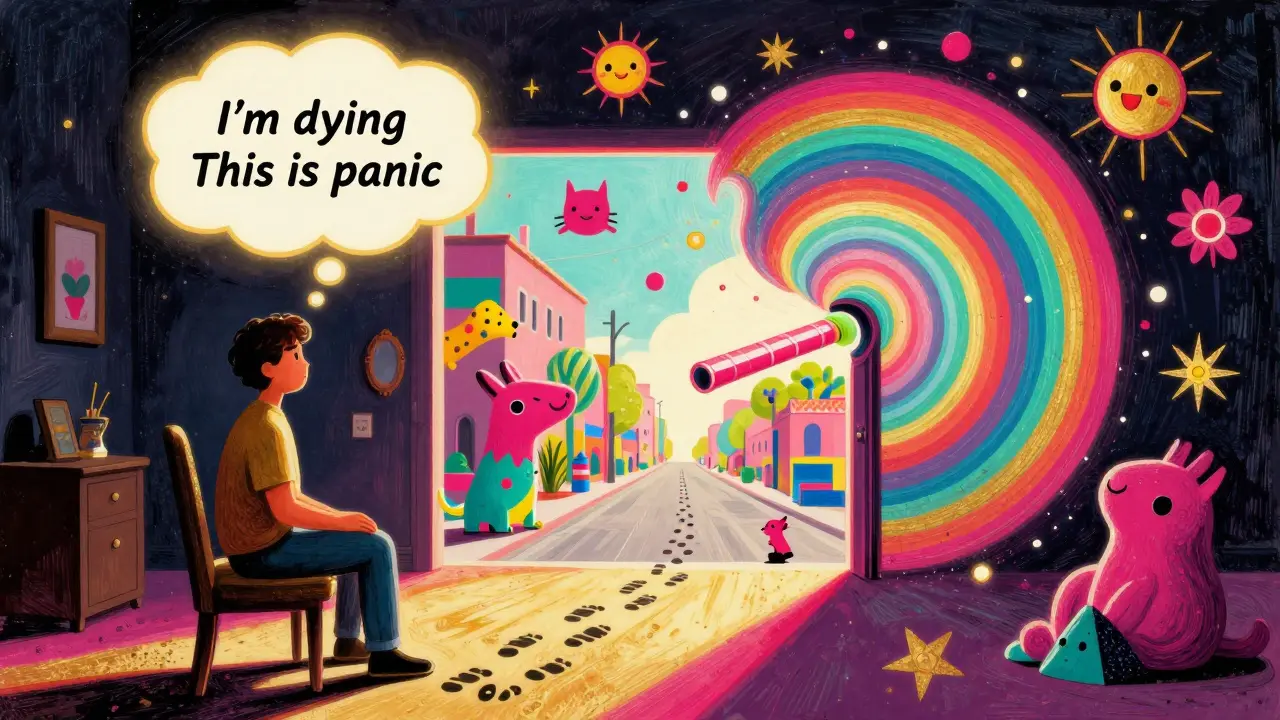
- Cognitive restructuring: You learn to challenge catastrophic thoughts. Instead of “My heart is racing-I’m having a heart attack,” you learn to say, “This is panic. It’s scary, but it’s not dangerous.”
- Interoceptive exposure: You deliberately trigger physical sensations to prove they’re harmless. You spin in a chair until you feel dizzy. You breathe through a straw until you’re light-headed. You run in place until your heart pounds. Over time, your brain learns: These feelings don’t mean I’m dying.
- In vivo exposure: You slowly face the places you’ve been avoiding. First, you stand outside your front door. Then you walk to the mailbox. Then you sit in your car for five minutes. Then you drive to the end of the street. Each step is practiced until the fear drops by half.
Most people see big improvements in 12-15 weekly sessions. One study found that 80% of patients cut their panic symptoms by 50% within 8-12 weeks.
Medication: Help, But Not a Fix
Medications can help-especially when panic is severe or CBT isn’t available.
SSRIs like sertraline and paroxetine are first-line drugs. They take 6-12 weeks to work, but once they do, 60-75% of people see major improvement. Side effects? Nausea, weight gain, emotional numbness. One user on Reddit said they gained 35 pounds on paroxetine and felt like a zombie. That’s common-about 40% of users report emotional blunting.
Benzodiazepines like alprazolam work fast. They calm you down in minutes. But they’re risky. Thirty to forty percent of long-term users become dependent. Withdrawal can trigger rebound panic worse than before. Doctors now avoid prescribing them for more than a few weeks.
D-cycloserine is a newer option. Taken before CBT sessions, it helps your brain learn faster. In one trial, it boosted treatment success by 28%.
The best results? Combining CBT with SSRIs. Studies show 85% of people reach remission with both. Alone, CBT gets you to 70%. Medication alone? Only 60-65%. And if you stop meds without doing therapy? Sixty percent relapse within six months.
What About Digital Tools?
Technology is changing access. Apps like CalmWave, cleared by the FDA in May 2023, deliver full CBT programs through your phone. It tracks your breathing, guides exposure exercises, and gives feedback. In a 24-week trial, 62% of users no longer met criteria for panic disorder.
Other apps, like Columbia University’s Panic Relief, have shown 65% adherence rates and strong results-comparable to in-person therapy. They’re not a replacement, but they’re a lifeline for people who can’t find a therapist, live in rural areas, or can’t afford care.
Why So Many People Go Undiagnosed
Most people with panic disorder don’t see a mental health professional right away. They go to the ER.
A 2023 survey found that 52% of people with panic disorder first went to the emergency room, convinced they were having a heart attack. The average delay between first symptoms and diagnosis? Over seven years.
Doctors miss it because panic attacks mimic heart disease, asthma, even neurological disorders. And because panic disorder doesn’t show up on blood tests or X-rays, it’s easy to overlook.
But there’s a tool doctors use: the Panic Disorder Severity Scale (PDSS). A score of 9 or higher means moderate to severe panic-and that it’s time for structured treatment.
Long-Term Outlook
With proper treatment, 65% of people achieve lasting remission. That means no more panic attacks, no more agoraphobia, no more living in fear.
But recovery isn’t always linear. About 25% of people have one or two relapses later in life-usually after a big stressor: a divorce, a job loss, the death of someone close. That’s why maintenance matters. Quarterly check-ins, breathing practice, and exposure reminders keep the fear from creeping back.
And here’s the truth: panic disorder doesn’t define you. It’s a brain glitch, not a character flaw. You didn’t cause it. You can’t just “snap out of it.” But you can learn to outgrow it.
One person wrote on a support forum: “I used to think panic meant I was broken. Now I know it just means I’m human-and I’m healing.”
Can panic attacks cause a heart attack?
No. Panic attacks don’t cause heart attacks. While symptoms like chest pain, rapid heartbeat, and shortness of breath feel identical to cardiac events, they’re caused by adrenaline surges and hyperventilation-not blocked arteries. However, if you’re unsure whether it’s panic or a heart issue, especially if you have risk factors like high blood pressure or diabetes, always seek medical evaluation to rule out cardiac causes.
Is agoraphobia the same as being shy or introverted?
No. Introversion is a personality trait-people who prefer quiet or small groups. Agoraphobia is a fear-based avoidance driven by panic. Someone with agoraphobia may want to go out but feels physically trapped by terror. They don’t avoid crowds because they’re shy-they avoid them because their body screams danger.
How long does CBT take to work for panic disorder?
Most people start seeing improvement within 4-6 weeks. After 12-15 weekly sessions, 70-80% experience a 50-70% reduction in panic attacks. The key is consistency: practicing exposure and thought-challenging daily, not just during therapy. Some people need up to 20 sessions if they have severe agoraphobia or co-occurring depression.
Can you cure panic disorder without medication?
Yes. Many people fully recover using CBT alone. Medication helps speed up recovery or manage severe symptoms, but it’s not required. The most durable results come from learning how to manage fear without drugs. Studies show that people who use only CBT have lower relapse rates than those who rely on medication alone.
What should I do if I think I have panic disorder?
Start by seeing your doctor to rule out medical causes like thyroid issues or heart problems. Then ask for a referral to a therapist trained in CBT for anxiety. If therapy isn’t accessible, try a clinically validated app like CalmWave or Panic Relief. Keep a journal of your attacks-note time, triggers, symptoms, and thoughts. This helps both you and your therapist track progress. You don’t have to suffer in silence. Help is effective-and it works.
Michelle M
December 16, 2025 AT 03:38Panic disorder isn't weakness. It's your brain's alarm system stuck on fire mode. I used to think I was losing my mind until I learned it was just my amygdala overreacting. The body doesn't lie - but it doesn't always tell the truth either. What feels like a heart attack is just adrenaline screaming into a vacuum. The real enemy isn't the panic - it's the fear of the panic. And that's what CBT breaks.
Melissa Taylor
December 16, 2025 AT 18:07You're not broken. You're just wired differently. I spent years hiding in my apartment, terrified of the grocery store. Then I started small - just stepping outside for 30 seconds. Then five. Then ten. Now I take the bus. It didn't happen overnight. But it happened. You can do this.
Cassie Henriques
December 18, 2025 AT 07:08Neurobiologically, the locus coeruleus-norepinephrine axis is hyperactive in 70% of cases - that’s a key pathophysiological marker. Coupled with amygdala hyperactivation and HPA axis dysregulation, this creates a feedforward loop of interoceptive misattribution. CBT works because it induces neuroplasticity - downregulating threat salience via prefrontal cortex modulation. D-cycloserine? That’s a glutamatergic NMDA co-agonist that enhances extinction learning. FDA-cleared apps like CalmWave are essentially digital exposure therapy engines with biofeedback integration. The data is robust.
Jake Sinatra
December 19, 2025 AT 02:02I appreciate the thorough breakdown. As someone who works in clinical psychology, I’ve seen too many patients dismissed in ERs for hours while their panic spirals. The PDSS is underutilized. Primary care providers need better training in recognizing panic as a neurological phenomenon - not a psychiatric ‘flaw.’ Medication has its place, but CBT is the only intervention that changes the brain’s architecture. Not just the symptoms - the wiring.
John Brown
December 19, 2025 AT 18:14Man, I used to think I was the only one who’d sit in the car for 20 minutes just to work up the courage to walk into a 7-Eleven. It’s not laziness. It’s not being dramatic. It’s your nervous system screaming ‘DANGER’ when there’s nothing there. I started with breathing exercises - 4-7-8, every time I felt it coming. Then I did one tiny exposure a day. No rush. No shame. Now I travel alone. It’s not perfect, but I’m free. You’re not alone.
Mike Nordby
December 21, 2025 AT 04:42The statistic that 52% of patients initially present to the ER is alarming - and entirely predictable. Emergency medicine is not equipped to diagnose anxiety disorders. Bloodwork is normal. EKG is normal. Chest X-ray is normal. So the patient is told, ‘It’s just anxiety.’ No treatment plan. No referral. No follow-up. This is systemic failure. We need mandatory mental health screening protocols in ERs for patients presenting with tachycardia, dyspnea, and chest pain - especially under age 40. Panic disorder is not a diagnosis of exclusion. It’s a diagnosis of recognition.
RONALD Randolph
December 21, 2025 AT 19:00Oh great. Another liberal brainwash piece. You’re telling people their panic is ‘just a glitch’? What about personal responsibility? Back in my day, people didn’t run to therapists every time their heart beat fast. You think America’s falling apart because of panic attacks? No. It’s because we’ve turned weakness into a identity. Pull yourself up. Stop coddling. Medication? That’s just chemical surrender. Go outside. Breathe. Stop being a victim.
Benjamin Glover
December 22, 2025 AT 15:53How quaint. The American obsession with ‘treatment’ and ‘recovery.’ In the UK, we call it ‘emotional dysregulation’ and move on. People here turn every physiological sensation into a clinical narrative. You don’t need apps. You don’t need therapy. You need discipline. And perhaps less screen time. This article reads like a pharmaceutical brochure disguised as science.
Raj Kumar
December 22, 2025 AT 21:23bro this is so real. i had panic attacks after my dad passed. i thought i was dying every time. then i found this app called panic relief - free on play store. did the breathing thing every day. started with just opening the door. now i go to the temple. no meds. just slow steps. you got this. its not your fault. your brain is just scared.
Christina Bischof
December 23, 2025 AT 17:23I remember sitting on my bathroom floor at 3 a.m., shaking, convinced I was going to die. I didn’t tell anyone for a year. I thought I was weak. Turns out, I was just scared. And scared people don’t need fixing. They need to know they’re not alone. This post? It’s that voice. Quiet. Clear. Real. Thank you.
Jocelyn Lachapelle
December 24, 2025 AT 06:10My sister went from housebound to hiking the Appalachian Trail in three years. She didn’t do it with drugs. She did it with a therapist who made her say ‘I’m safe’ out loud - even when she didn’t believe it. And then she did it again. And again. It’s not magic. It’s repetition. You don’t have to believe it. You just have to do it anyway.
John Samuel
December 24, 2025 AT 11:10As a neuroscientist who specializes in fear circuitry, I can confirm: the neuroplasticity induced by interoceptive exposure is among the most robust phenomena in behavioral neuroscience. The amygdala’s hyperactivity is not a character defect - it is a maladaptive synaptic reinforcement pattern. CBT doesn’t ‘change your thoughts’ - it restructures the thalamo-cortico-limbic feedback loop. D-cycloserine’s role as a cognitive enhancer during extinction learning is supported by fMRI data showing reduced amygdala activation and increased vmPFC connectivity. This isn’t pop psychology. It’s peer-reviewed, replicated, and life-altering.
Sai Nguyen
December 24, 2025 AT 20:50Why do we keep feeding this victim culture? Panic attacks? Agoraphobia? It’s all just excuses. Back in India, we didn’t have apps and therapists. We had grit. You don’t need to be ‘healed.’ You need to stop being soft. Stop blaming your brain. Take responsibility. Life doesn’t care if your heart races. Get up. Go out. Move. That’s the cure.