

Why Older Adults Struggle to Take Their Medications
Imagine waking up every morning to a table full of pills-ten different colors, shapes, and times to take them. One for blood pressure, two for diabetes, another for cholesterol, plus vitamins, painkillers, and a pill you’re told to take only on Tuesdays. Now imagine your hands shake a little, your eyesight isn’t what it used to be, and you’re not sure if you already took the blue one. This isn’t hypothetical. It’s the daily reality for millions of older adults.
According to the CDC, 88.6% of adults over 65 take at least one prescription drug. More than half take four or more. That’s polypharmacy in action. And with each added pill, the chance of missing, mixing up, or skipping a dose grows. The problem isn’t laziness. It’s complexity.
Many older adults don’t realize they’re taking too many medications. Doctors prescribe for one condition, then another, without stepping back to see the whole picture. A 78-year-old with heart disease, arthritis, and type 2 diabetes might be on eight different prescriptions. Some of them overlap. Some have side effects that make other conditions worse. And if they feel dizzy or confused, they might blame aging-not the medicine.
The Hidden Costs: When Money Stops Medications
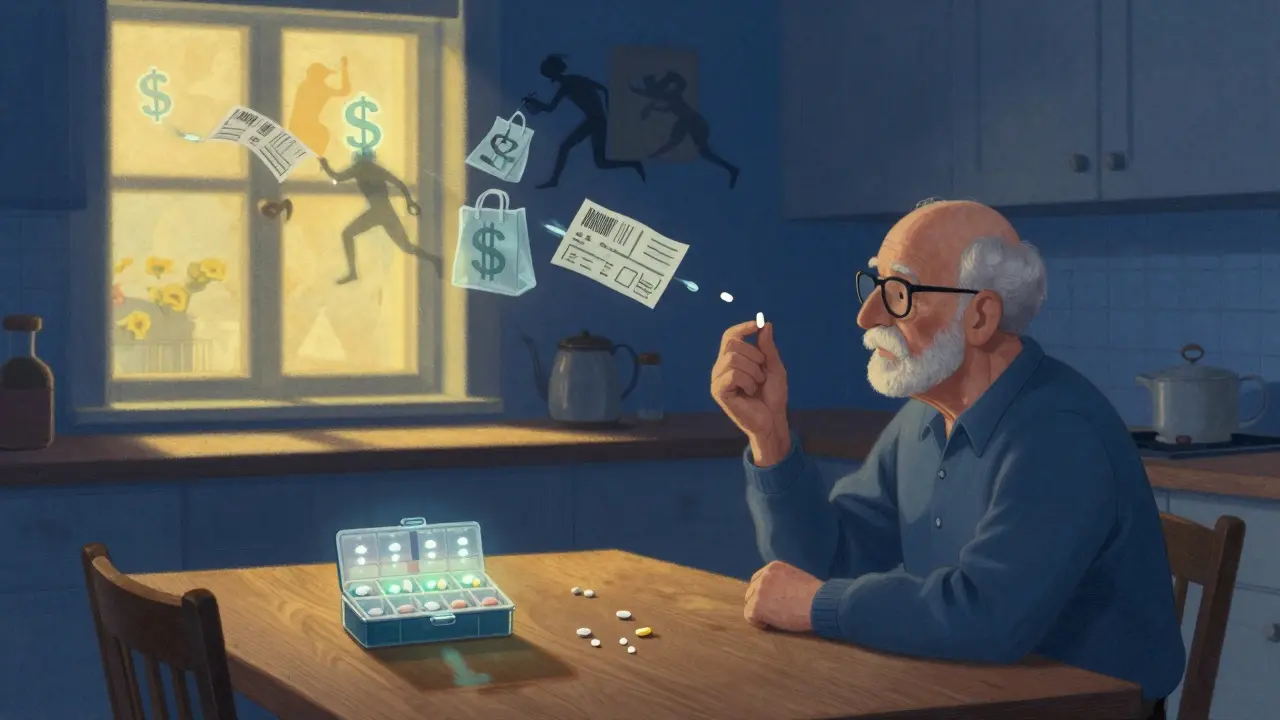
Cost isn’t just a number on a receipt. It’s a choice between medicine and groceries. Between pills and heating the house. Between refilling a prescription and paying the water bill.
The CDC found that 3.4% of older adults skip doses because they can’t afford them. That number jumps to 5.3% among Black and Hispanic seniors. For those facing food insecurity, the rate is six times higher. Women are more likely than men to cut pills to save money. And even with Medicare Part D coverage, out-of-pocket costs for brand-name drugs can still be unaffordable.
People don’t always say they’re skipping doses. They might say, “I’m feeling better, so I don’t need it anymore,” or “I’ll take it when I really need it.” But what they mean is, “I can’t afford to take it every day.”
Memory, Vision, and Hands That Don’t Cooperate
Forgetfulness is often blamed-but it’s not just about memory. It’s about how pills are packaged. A bottle with a childproof cap? Impossible to open with arthritic fingers. A blister pack with tiny print? Hard to read without reading glasses. A pill splitter that requires steady hands? Not possible when Parkinson’s tremors kick in.
Cognitive decline makes things worse. Someone might take a morning pill twice because they don’t remember taking it. Or skip an evening dose because they’re confused about the time. Some patients stop taking meds because they feel worse after starting them-nausea, dizziness, fatigue-and assume the drug is the problem. They don’t call their doctor. They just quit.
And here’s the cruel twist: those side effects? They’re often mistaken for aging. Falls. Confusion. Urinary incontinence. These aren’t normal parts of getting older. They can be signs of a bad drug interaction.
Family, Friends, and the Social Safety Net
One of the biggest factors in whether an older adult takes their meds? Whether someone is watching over them. Brazilian research shows social and family support is the top barrier-accounting for 33.6% of adherence issues.
Living alone? No one to remind you. No one to check the pill organizer. No one to notice if you’ve stopped eating or seem more confused than usual. Isolation is silent killer in medication adherence.
But it’s not just about having someone nearby. It’s about communication. Many seniors don’t ask questions because they’re afraid of sounding stupid. They don’t want to bother their doctor. Or they’ve been told for years, “Just take what the doctor gives you.”
On the flip side, seniors with strong support networks-children who help with refills, neighbors who check in, community volunteers who deliver meds-have much higher adherence rates. It’s not magic. It’s presence.
Solutions That Actually Work
There’s no single fix. But there are real, practical steps that make a difference.
1. Simplify the regimen. Ask the doctor: “Can we reduce the number of pills?” Many medications can be switched to once-daily versions. Combination pills (like a blood pressure pill that includes a diuretic) cut the count in half. If a drug was prescribed years ago and the condition has improved, maybe it’s time to stop.
2. Use a pill organizer with alarms. Simple plastic boxes with compartments for morning, afternoon, evening, and night help. But even better? Electronic dispensers that beep, flash, and even call a family member if a dose is missed. Some models connect to apps so caregivers know if a pill was taken.
3. Get help from a pharmacist. Pharmacists aren’t just pill dispensers. They’re medication detectives. Many offer free med reviews-going through every pill, checking for duplicates, side effects, and interactions. Medicare now covers these services for high-risk patients.
4. Reduce cost burdens. Ask about generic alternatives. Use mail-order pharmacies for 90-day supplies (often cheaper). Check if the drug manufacturer offers a patient assistance program. Some states have programs that cap out-of-pocket costs for seniors. And if you’re struggling to afford food and meds, talk to a social worker. There are resources.
5. Build a routine. Link pill-taking to something you already do every day: brushing your teeth, eating breakfast, watching the news. Consistency sticks better than reminders.
When Technology Helps-But Doesn’t Solve Everything
Smartphone apps, automated dispensers, and wearable reminders are growing in popularity. But they only work if the person can use them. A tablet with a big-button app? Great-if they know how to turn it on. A voice-activated assistant that says, “Take your metformin,”? Perfect-if the person can hear it clearly.
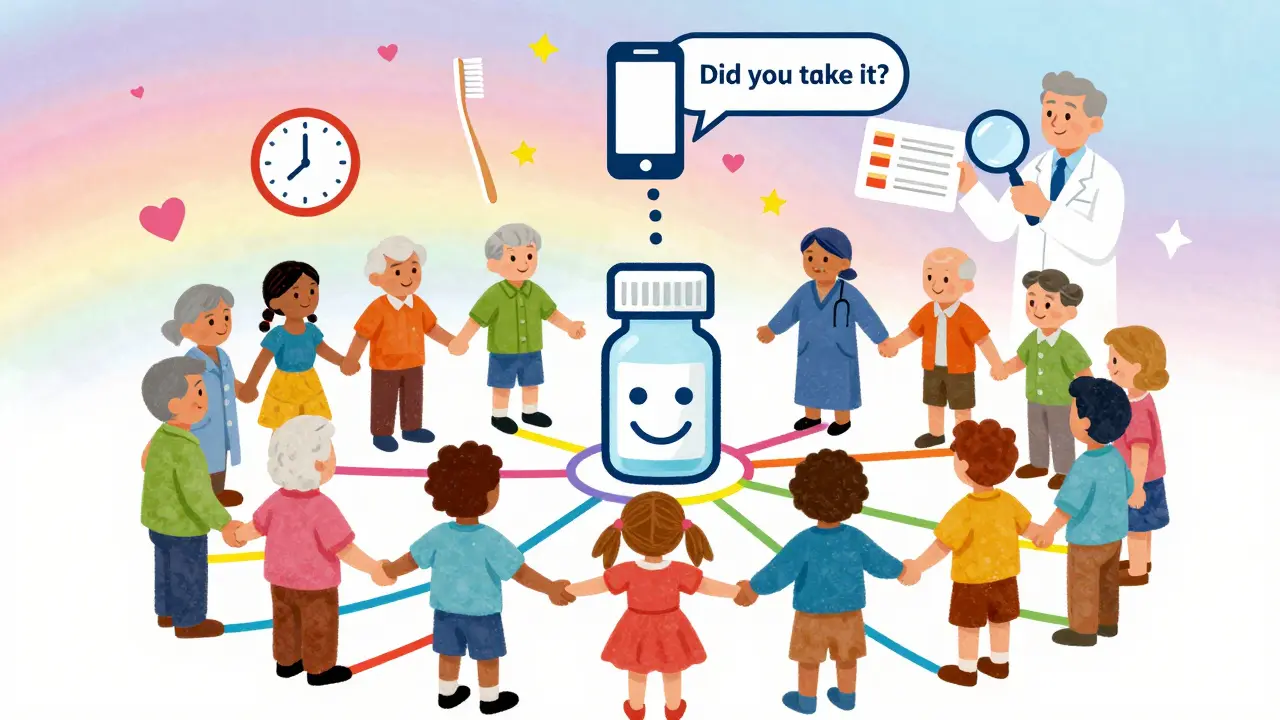
Technology is a tool, not a replacement for human care. The most effective systems combine tech with check-ins: a pharmacy calls every week. A community nurse visits monthly. A grandchild texts every morning: “Did you take your pills?”
One 82-year-old woman in Sydney told her nurse, “I’ve got an app that reminds me. But I still forget. So my neighbor, Marjorie, comes over at 8 a.m. every day and sits with me while I take them. That’s what works.”
What Families and Caregivers Can Do
You don’t need to be a nurse. You just need to be present.
- Go with your parent or relative to their next doctor visit. Bring a list of all meds-prescription, over-the-counter, supplements. Ask: “Which ones are still necessary?”
- Help organize pills into a weekly box. Label it clearly. Check it every Sunday.
- Don’t assume they’re taking meds just because the bottle is empty. Empty bottles can mean they sold them for cash.
- Watch for signs: weight loss, confusion, falls, mood changes. These could be side effects, not just aging.
- Ask: “Is there anything about your meds that’s hard to deal with?” Then listen. Don’t fix. Just listen.
Many seniors hide their struggles. They don’t want to be a burden. So you have to be the one to notice.
Final Thought: It’s Not About Compliance. It’s About Care.
Medication adherence isn’t about following rules. It’s about keeping people alive and independent. When older adults skip pills, it leads to hospitalizations, emergency rooms, and lost years of life. The NIH estimates that non-adherence causes around 200,000 deaths in the U.S. every year.
But the solution isn’t more pills. It’s fewer, simpler, cheaper, and better-supported regimens. It’s doctors listening. Pharmacists stepping in. Families showing up. Systems that recognize that taking a pill isn’t just a medical act-it’s a human one.
Medications don’t work if they’re not taken. And no amount of technology will fix that unless someone cares enough to make sure they are.
jeremy carroll
December 15, 2025 AT 19:53Man, this hits home. My pops is on 11 meds and he swears he takes 'em all, but I found half a bottle of his blood pressure stuff in the sock drawer last week. He said he forgot what they were for. Not laziness. Just overwhelmed.
Thomas Anderson
December 17, 2025 AT 06:58Simple fix: get a pill organizer with alarms. Got one for my grandma. She forgets her phone but remembers the box beeping. Also, pharmacies will pre-sort meds for free if you ask. No excuse.
Daniel Wevik
December 17, 2025 AT 21:11From a clinical perspective, polypharmacy in geriatric populations is a systems failure, not an individual compliance issue. The biomedical model fractures care into silos-cardiology, endocrinology, neurology-each prescribing in isolation. What’s needed is comprehensive geriatric assessment with deprescribing protocols embedded in primary care workflows. Medicare’s new med review coverage is a step, but underutilized due to provider inertia and lack of reimbursement incentives.
Additionally, cognitive load theory applies here: humans have limited working memory. A 78-year-old with executive dysfunction can’t manage 12 distinct dosing schedules. The solution isn’t more reminders-it’s reduction. Simplification. One pill, once daily, if possible.
Pharmacists are the unsung heroes here. They’re trained in pharmacokinetics, drug interactions, and adherence barriers. Yet they’re rarely integrated into care teams. We need pharmacist-led medication therapy management as standard of care, not an afterthought.
And cost? It’s a moral failure. A diabetic senior choosing between insulin and groceries isn’t noncompliant. They’re rational. We’ve built a system that forces impossible trade-offs. Generic substitution isn’t enough. We need price caps, bulk purchasing, and public drug manufacturing.
Technology helps, but only if designed with accessibility in mind. Big buttons. Voice prompts. No touchscreens. No apps requiring literacy. And always, always, human check-ins. No algorithm replaces a neighbor knocking on the door.
Sinéad Griffin
December 18, 2025 AT 07:09AMERICA NEEDS TO FIX THIS. 🇺🇸 My aunt died because she skipped her heart meds to pay for gas. This isn’t just a health issue-it’s a national disgrace. Why do we let old people choose between medicine and heat? We’re better than this. 🤬
Jonny Moran
December 19, 2025 AT 22:37My mom’s in her 80s and she’s got a routine now: pills after her morning coffee, every day. No excuses. We made a chart with pictures. She loves it. Small wins add up. You don’t need fancy tech-just consistency and someone who cares enough to help her stick to it.
Tim Bartik
December 21, 2025 AT 01:20They say 'just take your pills' like it's that easy. Meanwhile, the pharma bros are sipping champagne on their yachts while grandmas split pills in half to make 'em last. This whole system is rigged. Pills cost more than my rent. And don't even get me started on how the FDA lets these greedy bastards charge $500 for a bottle of metformin. It's a scam. A bloody scam.
Rich Robertson
December 21, 2025 AT 19:10I’m from the U.S., but I’ve seen this same thing in rural South Africa-older folks skipping meds because they can’t afford transport to the clinic, or the pills run out and no one’s there to refill. The solution isn’t just tech or policy. It’s community. Someone who checks in. A neighbor. A church volunteer. A kid who texts. That’s what keeps people alive.
It’s not about compliance. It’s about connection.
Daniel Thompson
December 21, 2025 AT 23:13It is imperative to note that the psychological burden of medication adherence is frequently underestimated. The cognitive dissonance experienced by elderly patients who perceive their regimen as excessive or unnecessary is profound. Furthermore, the institutionalized ageism within healthcare systems often leads to therapeutic nihilism-where clinicians assume that because a patient is elderly, aggressive management is futile. This mindset perpetuates under-treatment and abandonment of pharmacologic interventions.
Moreover, the notion that patients are 'noncompliant' is a misattribution of systemic failure. The burden of adherence is placed entirely on the individual, despite the fact that the complexity of the regimen is engineered by the system. This is a failure of design, not of willpower.
Alexis Wright
December 23, 2025 AT 05:57Let’s be brutally honest: 88.6% of seniors are on meds because the medical-industrial complex needs to sell something. Most of these prescriptions were never meant to be lifelong. But once you’re hooked, they won’t let you go. Doctors don’t want to admit they overprescribed. Pharmacies make money on refill cycles. Insurance companies profit from chronic disease management. And the patient? They’re just a revenue stream with a heartbeat.
That’s why deprescribing is rare. It’s not medical-it’s economic. They’d rather keep you on five pills than admit they gave you too many in the first place. And don’t even get me started on how 'vitamins' are just placebos sold for $40 a bottle.
Real solution? Stop treating aging like a disease to be managed with pills. Let people die naturally instead of drugging them into a slow, overmedicated twilight.
Edward Stevens
December 24, 2025 AT 19:05Wow. So the solution to 12 pills a day is… more pills? A pill organizer? That’s like putting a Band-Aid on a gunshot wound. The real problem is that we treat aging like a bug to be patched with pharmaceuticals instead of accepting it as a natural process. And now we’ve got apps that text your grandkids if you miss a pill. Cute. But it’s not care. It’s surveillance.
Wade Mercer
December 25, 2025 AT 03:37People like you think this is all about 'compassion.' But what about personal responsibility? If you can’t manage your own meds, maybe you shouldn’t be living alone. Someone needs to step in. Not the government. Not the pharmacist. A family member. If you can’t handle your pills, you lose your independence. Simple as that.
Natalie Koeber
December 25, 2025 AT 16:32Did you know the FDA approves most drugs based on trials with people under 65? So every pill these seniors are taking? It was never tested on them. They’re guinea pigs. And the 'med reviews'? That’s just a loophole so doctors can keep billing. Big Pharma owns this whole system. Wake up.
Rulich Pretorius
December 25, 2025 AT 21:48Here’s what I’ve learned in 40 years as a geriatric nurse: the most effective intervention isn’t a device, a discount, or even a doctor. It’s a quiet presence. Someone who sits with them. Who asks, 'How’s your stomach today?' Not 'Did you take your pills?' That’s the difference between compliance and care. The pills are just the surface. The real medicine is being seen.