
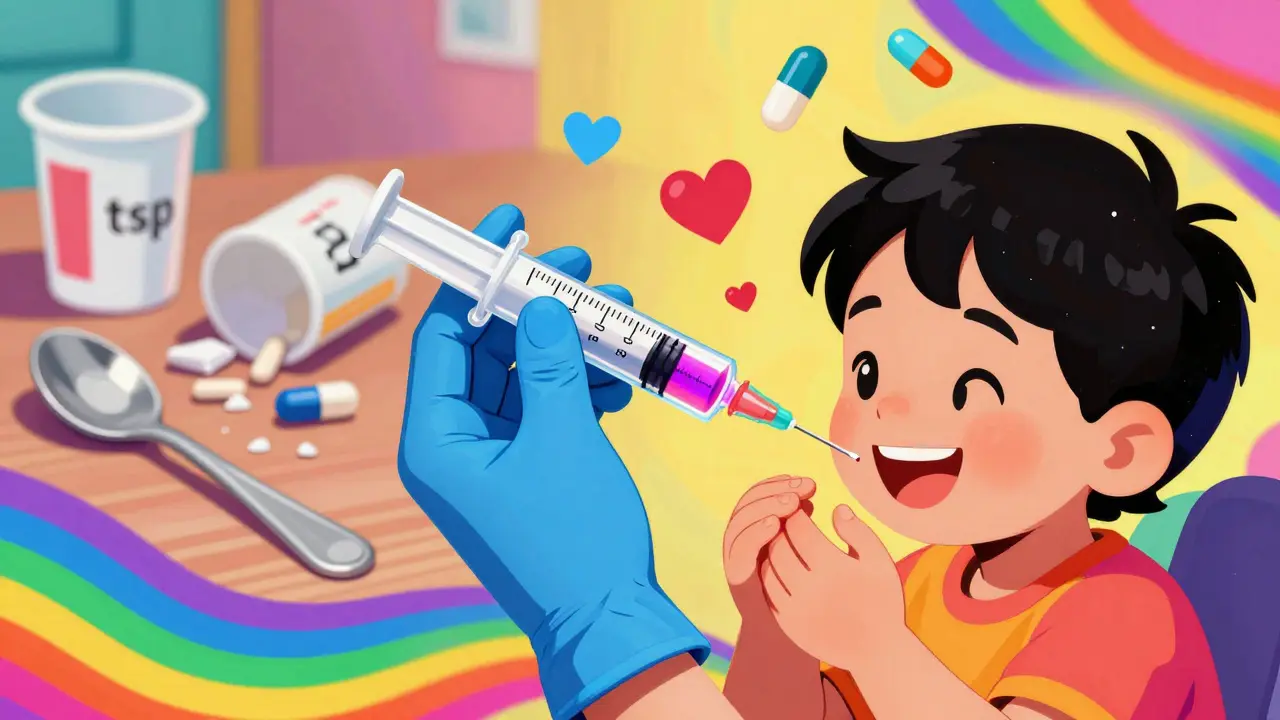
Getting the right dose of liquid medication isn’t just important-it’s life-or-death. A child given too much acetaminophen can suffer liver damage. An elderly patient given too little antibiotics might not recover from an infection. And yet, wrong-dose errors with liquid medications are shockingly common. In fact, about 80% of pediatric home medication errors involve incorrect liquid doses, according to a 2023 study in the Journal of Pediatrics. These aren’t rare mistakes. They happen every day-in hospitals, clinics, and homes-because we’re still using outdated tools and practices.
Why Liquid Medications Are So Dangerous
Liquid medications are tricky because they’re easy to measure wrong. A teaspoon isn’t a teaspoon. A tablespoon isn’t consistent. And most people don’t own a proper measuring device. A 2024 Reddit thread with over 1,200 parent comments found that 68% had used a kitchen spoon to give medicine at least once. That’s not carelessness-it’s a system failure. The problem starts at the prescription. Some doctors still write “5 mL” or “1 tsp.” But teaspoons vary by country, by spoon, by how full you pour. The Institute for Safe Medication Practices says 28% of preventable pediatric errors come from this confusion. Even worse, some pharmacies still hand out dosing cups with unclear markings. A 2021 study in Academic Emergency Medicine showed that dosing cups had a 41.1% error rate for doses under 5 mL. Oral syringes? Just 8.2%. Then there’s packaging. Look-alike bottles. Similar colors. Tiny print. One caregiver told Healthgrades she gave her toddler double the dose because the bottle looked like another medicine she’d used before. That’s not her fault-it’s bad design.The Only Tool That Works: Oral Syringes
If you’re giving liquid medicine to a child, elderly person, or anyone who needs precision, use an oral syringe. Not a cup. Not a spoon. Not a dropper. An oral syringe with clear milliliter (mL) markings. Here’s what you need to know:- For doses under 1 mL, use a syringe with 0.1 mL graduations.
- For doses between 1-5 mL, use one with 0.5 mL graduations.
- Never use a syringe meant for injections-those are for needles, not mouths.
- Always draw up the dose slowly, check the line at eye level, and give it directly into the cheek, not the throat.
Stop Using Teaspoons and Tablespoons
The biggest single fix? Eliminate non-metric units from prescriptions and labels. That means no more “teaspoon,” “tablespoon,” or “cc.” Only mL. The World Health Organization calls this the most effective intervention-preventing 33% of all liquid medication errors. The American Society of Health-System Pharmacists (ASHP) and the Joint Commission now require it. The FDA’s 2024 draft guidance mandates metric-only labeling on all over-the-counter liquid medicines. If you see a prescription that says “give 1 tsp,” ask the prescriber to rewrite it in mL. If the bottle says “take one tablespoon,” return it to the pharmacy and demand a label that says “5 mL.”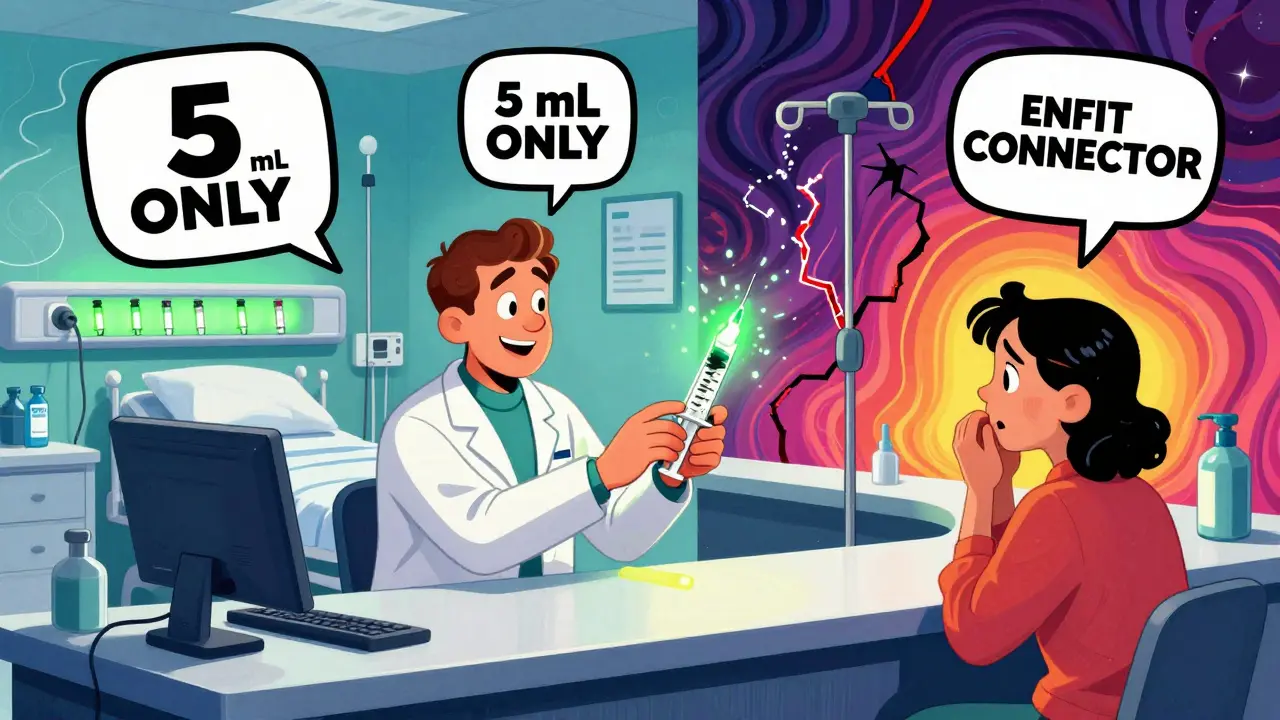
ENFit Connectors: Preventing Deadly Mix-Ups
Another silent killer? Giving liquid medicine through an IV line by accident. It happens. And it kills. Since 2016, the international standard ENFit has required all enteral (tube-fed) liquid medications to have a unique connector that physically won’t fit into IV tubing. Before ENFit, a simple misconnection could send feeding formula straight into a vein-causing air embolism, organ failure, or death. Hospitals that switched to ENFit saw wrong-route errors drop by 98%, according to ASHP guidelines (2023). But only 42% of U.S. hospitals have fully adopted it. Pediatric units are ahead (68%), but adult wards lag behind (32%). If you’re managing care at home with a feeding tube, make sure the syringe and tube connector are labeled “ENFit.” If they’re not, ask your provider for an updated system. It’s not optional-it’s a safety requirement.Technology That Actually Helps
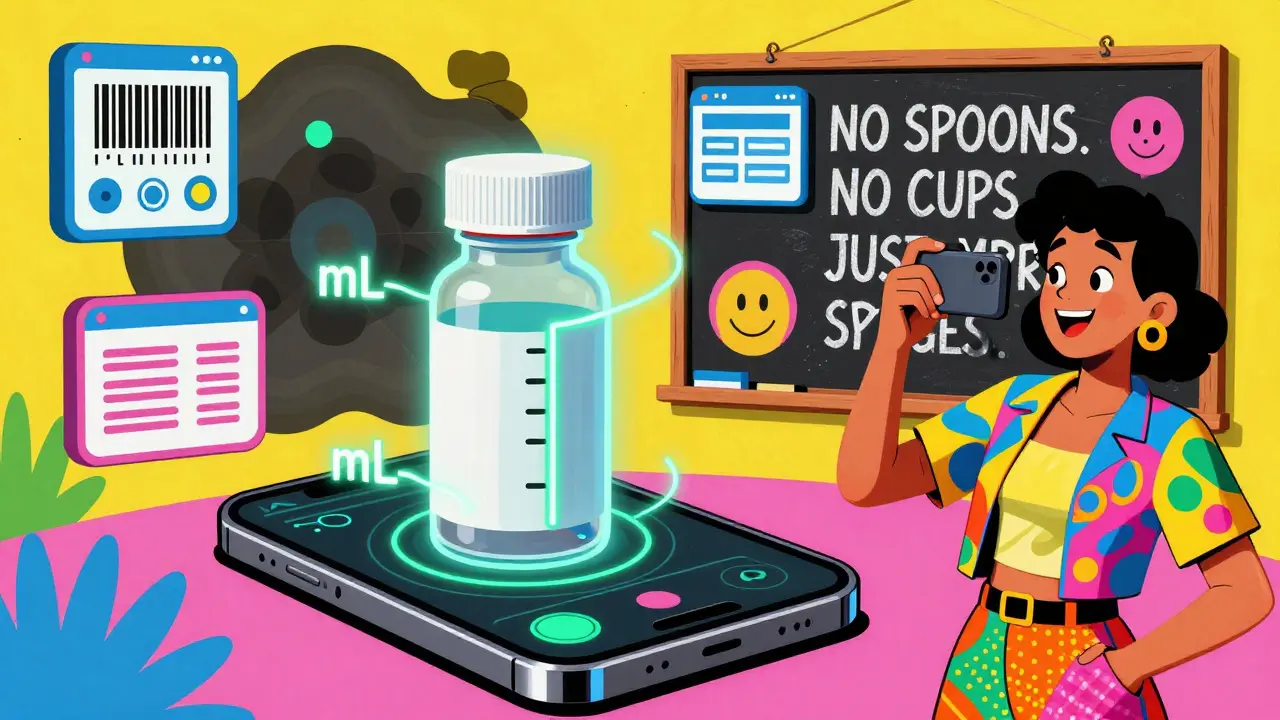
Technology isn’t magic, but when used right, it saves lives. In hospitals, barcode medication administration (BCMA) systems scan the patient’s wristband and the medication before giving it. Studies show they reduce wrong-dose errors by 48%. But only if used every single time. If staff bypass the scan to save time, the system fails. Electronic prescribing (e-prescribing) with built-in clinical decision support is even better. Systems that flag doses outside 20% of standard weight-based ranges cut pediatric errors by 58%, per a 2023 Cochrane Review. If your doctor’s office still uses paper scripts, ask why. Digital systems also auto-calculate doses based on weight-no more manual math errors. At home, smart apps are emerging. Boston Children’s Hospital is testing augmented reality apps that let you point your phone at a bottle and see the correct dose highlighted. Johns Hopkins has a pilot with RFID-tagged syringes that log doses directly into the EHR. These aren’t sci-fi-they’re coming fast.What Caregivers Can Do Right Now
You don’t need a hospital budget to prevent errors. Here’s your action plan:- Always ask for an oral syringe when picking up liquid medicine. If they don’t give you one, ask for it again. Keep extras at home.
- Throw out any dosing cups that have non-metric markings. If the cup says “tsp” or “tbsp,” it’s unsafe.
- Write down the dose in mL on a sticky note and keep it with the medicine.
- Use the syringe every time-even if the medicine looks like water. Never guess.
- Store syringes separately from other household tools. Don’t let kids play with them.
- Take a photo of the prescription label and the syringe reading before giving the dose. It helps if you’re unsure.
What Clinicians and Pharmacies Must Do
If you’re a doctor, nurse, or pharmacist, your role is critical.- Prescribe all liquid medications in mL only. No exceptions.
- Always dispense an oral syringe with pediatric and geriatric liquid meds. Cost is under $1 per unit.
- Label all bottles with bold, high-contrast text: “FOR ORAL USE ONLY.” Use ANSI Z535.4-2011 standards.
- Train staff on ENFit compatibility. If your pharmacy still stocks non-ENFit enteral syringes, replace them immediately.
- Use e-prescribing with dose-check alerts. Don’t rely on memory or paper.
- Offer a 15-minute caregiver education session when dispensing liquid meds. Most patients don’t know how to measure correctly.
What’s Changing in 2026
By 2026, every certified electronic health record in the U.S. must include automatic pediatric dose checking, thanks to the ONC’s Interoperability Rule. The FDA will require all OTC liquid medicines to come with a compliant dosing device. ENFit will be mandatory for all new enteral products. The market for safety tech is growing fast-projected to hit $2.1 billion by 2027. But progress isn’t automatic. Rural clinics still struggle with cost. Staff are overworked. Training is skipped. The truth? Most wrong-dose errors aren’t caused by bad people. They’re caused by bad systems.Final Thought: It’s Not About Being Careful. It’s About Being Set Up Right.
You can’t rely on memory, good intentions, or “being careful.” A 2022 study from Harvard Medical School showed hospitals that implemented full safety bundles-including syringes, metric labels, ENFit, and staff training-reduced serious errors by 67% in just 18 months. The fix isn’t complicated. It’s simple: use the right tool, use metric units, and never assume. If you’re giving liquid medicine, use a syringe. If you’re prescribing it, write mL. If you’re dispensing it, include the tool. If you’re managing care, ask for proof it’s safe. Because when it comes to liquid medications, there’s no room for guesswork.Why are dosing cups dangerous for liquid medications?
Dosing cups are dangerous because their markings are often unclear, inconsistent, or include non-metric units like teaspoons. Studies show they have a 41% error rate for doses under 5 mL, compared to just 8% for oral syringes. Many caregivers misread the lines, pour incorrectly, or use the wrong cup. The American Academy of Family Physicians recommends eliminating dosing cups entirely for pediatric use.
Can I use a kitchen spoon if I don’t have a syringe?
No. Kitchen spoons vary widely in size-even tablespoons can range from 10-20 mL. A 2024 Reddit survey of over 1,200 parents found that 41% had made a dosing error after using a spoon. Never rely on household utensils. If you don’t have a syringe, call your pharmacy. They’re required to provide one free of charge.
What’s the difference between mL and cc?
One milliliter (mL) equals one cubic centimeter (cc). They’re the same volume. But “cc” is outdated and confusing. It’s not used in modern medical practice and can be mistaken for other units. All prescriptions and labels should use mL only. The World Health Organization and ISMP recommend eliminating “cc” entirely.
Is ENFit only for hospitals?
No. ENFit connectors are required for any liquid medication given through a feeding tube-whether at home, in a nursing facility, or in a hospital. If you or a loved one uses a G-tube or NG-tube, make sure the syringe and tube connector are labeled ENFit. Non-ENFit connectors can accidentally connect to IV lines, which can be fatal.
How can I check if my pharmacy gives the right dosing tool?
When you pick up a liquid prescription, ask: “Do you have an oral syringe with mL markings?” If they say no, ask to speak to the pharmacist. Under ASHP and Joint Commission guidelines, they’re required to provide one. If they refuse, file a complaint with your state pharmacy board. You’re entitled to the safest tool available.
Are there apps that help prevent dosing errors?
Yes. Apps like DoseMe and Medisafe now include liquid medication calculators and reminders. Boston Children’s Hospital is testing augmented reality apps that use your phone camera to highlight the correct dose level on the bottle. These aren’t mainstream yet, but they’re coming. Always pair them with a physical syringe-don’t rely on the phone alone.
What should I do if I think I gave the wrong dose?
Call your doctor or poison control immediately. Don’t wait for symptoms. Even if you’re unsure, it’s better to be safe. In Australia, call 13 11 26 (Poison Information). In the U.S., call 1-800-222-1222. Keep the medicine bottle and syringe with you when you call. They’ll need the name, dose, and time given.
Sarah Mailloux
January 16, 2026 AT 17:32Don't be like me.
Nilesh Khedekar
January 17, 2026 AT 21:34RUTH DE OLIVEIRA ALVES
January 19, 2026 AT 10:02Tom Doan
January 20, 2026 AT 13:53Dan Mack
January 20, 2026 AT 15:57Amy Vickberg
January 22, 2026 AT 04:50Nicholas Urmaza
January 24, 2026 AT 02:38Stop making excuses
Get the tool
Use it every time
It’s that simple
Amy Ehinger
January 25, 2026 AT 06:20Jan Hess
January 26, 2026 AT 07:33Gloria Montero Puertas
January 26, 2026 AT 18:31Annie Choi
January 28, 2026 AT 17:55Arjun Seth
January 29, 2026 AT 13:55Nishant Garg
January 31, 2026 AT 01:14