

Decongestant Safety Checker
Check Your Decongestant Safety
Enter your blood pressure reading and the decongestant ingredient you're considering to determine if it's safe for you.
Many people reach for decongestants when they have a stuffy nose. It’s quick, easy, and available over the counter. But if you have high blood pressure, that little bottle of Sudafed or a multi-symptom cold tablet could be more dangerous than you think. The problem isn’t just about feeling jittery or having a racing heart-it’s about your blood pressure spiking suddenly, sometimes to dangerous levels. And it’s not rare. Around 1 in 10 people with hypertension experience a significant rise in blood pressure after taking decongestants, according to UI Health Care. For someone already struggling to keep their numbers in check, that spike can mean the difference between a bad day and a trip to the emergency room.
How Decongestants Work (and Why They Raise Blood Pressure)
Decongestants like pseudoephedrine and phenylephrine don’t just shrink swollen nasal passages-they tighten blood vessels everywhere in your body. That’s how they reduce congestion: by narrowing the tiny blood vessels in your nose. But that same effect happens in your arteries, veins, and heart. When those vessels constrict, your heart has to pump harder to push blood through tighter spaces. That’s what raises your blood pressure.
It’s not a small change. A 2023 meta-analysis in US Pharmacist found that even standard doses of pseudoephedrine can increase systolic blood pressure by 2 to 5 mm Hg on average. For most people, that’s not a big deal. But if your blood pressure is already at 150/90 or higher, a 5-point jump can push you into a dangerous zone. Some people, especially those with uncontrolled hypertension, see spikes of 20 mm Hg or more. That’s not a fluke-it’s a known risk.
And it’s not just oral pills. Nasal sprays like Afrin (oxymetazoline) can do the same thing. Even though they’re applied locally, some of the medicine gets absorbed into your bloodstream. One case study from US Pharmacist tracked a 5-year-old girl whose blood pressure climbed to 135/80 after using a phenylephrine nasal spray for four days. Her numbers went back to normal only after she stopped.
Which Decongestants Are the Biggest Concern?
Not all decongestants are created equal. The two main culprits are:
- Pseudoephedrine (Sudafed, Claritin-D, Zyrtec-D)
- Phenylephrine (Sudafed PE, Robitussin Peak Cold, many store-brand cold remedies)
Pseudoephedrine has been studied the most. Since at least 2005, research has shown it reliably raises blood pressure-even in people without hypertension. That’s why it’s kept behind the pharmacy counter in the U.S. under the Combat Methamphetamine Epidemic Act. Pharmacists are supposed to ask if you have high blood pressure before selling it. But many people don’t realize they’re buying pseudoephedrine at all. They just see “cold and flu” on the label.
Phenylephrine is now the more common decongestant on shelves, after manufacturers switched from pseudoephedrine due to legal restrictions. But here’s the twist: studies show phenylephrine might be less effective at relieving congestion than pseudoephedrine. And it still raises blood pressure. A 2023 review in Pharmacy Times found no strong evidence that phenylephrine is safer for hypertensive patients. So switching from Sudafed to Sudafed PE doesn’t solve the problem-it just changes the brand.
Who’s at Highest Risk?
If you have high blood pressure, you’re not all the same. Some people can take a low dose of decongestant with no issues. Others can’t. The American Heart Association and Mayo Clinic agree: the risk is highest if you have:
- Uncontrolled high blood pressure (numbers consistently above 140/90)
- Heart disease, including past heart attacks or heart failure
- Irregular heart rhythms (arrhythmias)
- Prinzmetal angina (a rare type of chest pain caused by artery spasms)
- Diabetes or kidney disease
Dr. Al-Kindi from Houston Methodist puts it simply: “The caution is for people who have a health issue that affects how well the heart and vascular system are functioning.” If your body is already working hard to manage blood pressure, adding a decongestant is like stepping on the gas while your brakes are worn out.
And it’s not just about the decongestant alone. Mixing it with certain antidepressants-like MAO inhibitors (Marplan, Nardil) or tricyclics (Amitriptyline)-can cause a sudden, life-threatening surge in blood pressure. Even some herbal supplements like St. John’s Wort can interact dangerously. That’s why it’s never safe to assume “it’s just a cold medicine.”
What’s in Your Medicine Cabinet?
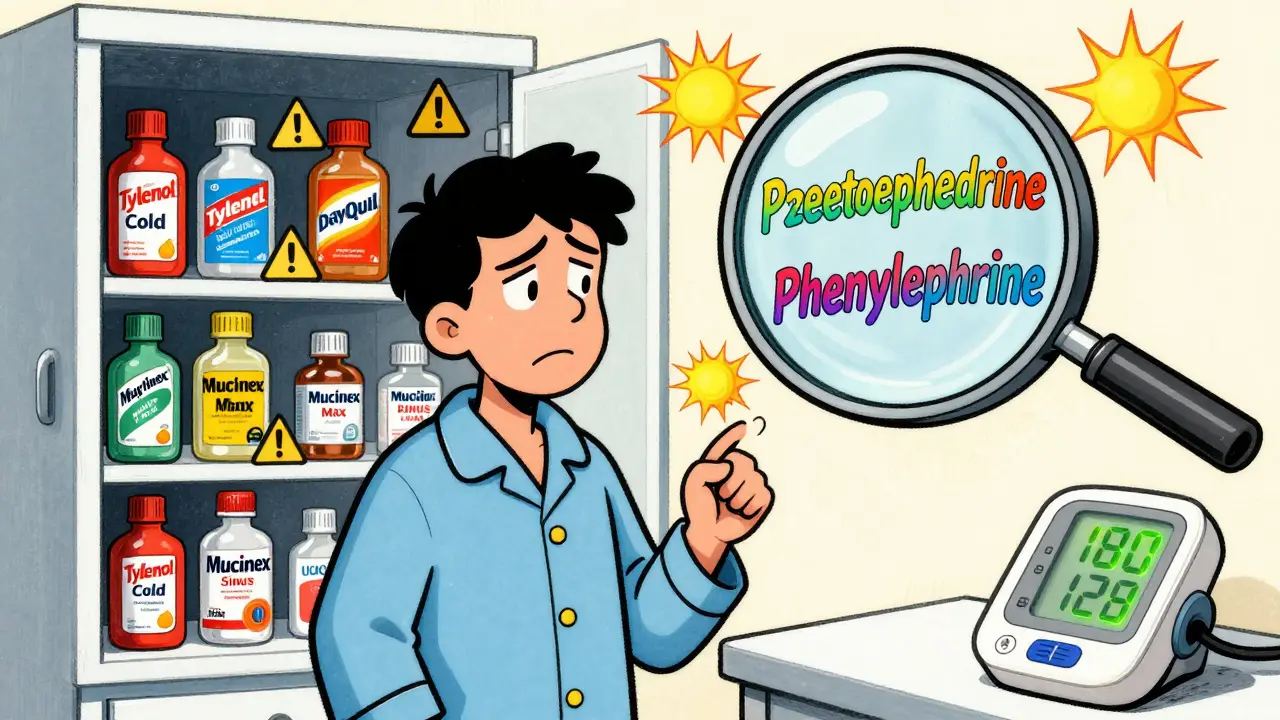
Most people don’t realize decongestants are hidden in dozens of common OTC products. You might think you’re just taking a pain reliever or allergy pill-but look closer. Here are the most common culprits:
- Tylenol Cold and Flu
- Advil Multi-Symptom Cold and Flu
- Benadryl Allergy Plus Congestion
- Mucinex Sinus Max
- DayQuil and NyQuil (most versions)
- Alka-Seltzer Plus Cold and Cough
Always check the “Active Ingredients” section on the label. Look for these words:
- Pseudoephedrine
- Phenylephrine
- Ephedrine
- Naphazoline
- Oxymetazoline
And don’t forget about sodium. Some liquid cold medicines use sodium as a preservative. If you’re on a low-sodium diet for your blood pressure, that’s another hidden risk. A single dose of some syrups can contain over 200 mg of sodium-nearly 10% of your daily limit.
What Can You Use Instead?
You don’t have to suffer through a stuffy nose. There are safer ways to relieve congestion without raising your blood pressure:
- Saline nasal sprays-these just flush out mucus and irritants. No drugs. No side effects.
- Steam inhalation-breathe in warm, moist air from a bowl of hot water or a hot shower. It loosens mucus naturally.
- Humidifiers-keeping the air moist helps your nasal passages stay clear.
- Antihistamines without decongestants-like loratadine (Claritin) or cetirizine (Zyrtec). These help with allergies but won’t raise your blood pressure.
- Neti pots-if used with distilled or boiled water, they’re safe and effective for flushing out sinuses.
Mayo Clinic recommends trying these first, especially if your blood pressure isn’t well-controlled. Even safe alternatives should be discussed with your doctor if you’re on multiple medications. What’s harmless for one person might interfere with another’s treatment.

What Should You Do If You’ve Already Taken One?
If you took a decongestant and didn’t know you had high blood pressure-or if you took it despite knowing-you need to watch for warning signs:
- Headache
- Blurred vision
- Chest pain or tightness
- Rapid or irregular heartbeat
- Severe dizziness or fainting
These could mean your blood pressure has spiked dangerously. If you feel any of these, stop the medication immediately. Sit down, stay calm, and check your blood pressure if you have a home monitor. If it’s over 180/120, or if you have chest pain or trouble breathing, call emergency services. Don’t wait.
If you’re unsure whether you’re at risk, talk to your pharmacist. They’re trained to spot these interactions. In fact, pharmacists at major chains spend 3 to 5 minutes per customer during cold season just explaining these risks. That’s because they see the results every day-people who thought “it’s just a cold medicine” and ended up in the ER.
Bottom Line: Don’t Guess. Ask.
Just because a medicine is sold over the counter doesn’t mean it’s safe for everyone. The American Heart Association’s message is clear: “Just because it’s available without a prescription doesn’t mean it’s safe for everyone.”
If you have high blood pressure:
- Avoid all decongestants unless your doctor says it’s okay.
- Read every label-look for pseudoephedrine or phenylephrine.
- Use saline sprays, steam, or humidifiers instead.
- Ask your pharmacist before buying anything for a cold or flu.
- Monitor your blood pressure more often if you’re sick.
Your heart doesn’t need another burden. A stuffy nose will pass. A stroke or heart attack won’t.
Can I take pseudoephedrine if my blood pressure is controlled?
Some people with well-controlled hypertension can take low doses of pseudoephedrine under medical supervision. But even then, your blood pressure should be monitored closely. Extended-release forms are less likely to cause spikes than immediate-release versions. Still, most doctors recommend avoiding it entirely unless there’s no other option. Always talk to your doctor or pharmacist first.
Is phenylephrine safer than pseudoephedrine for high blood pressure?
No. While phenylephrine is less effective at relieving congestion, it still raises blood pressure. Studies show it has similar cardiovascular effects as pseudoephedrine in hypertensive patients. The switch from pseudoephedrine to phenylephrine in many products was driven by legal restrictions, not safety. Don’t assume you’re safer just because the label says “PE.”
Can nasal sprays like Afrin raise blood pressure?
Yes. Even though they’re applied to the nose, a small amount of oxymetazoline (the active ingredient in Afrin) gets absorbed into your bloodstream. This can cause a rise in blood pressure, especially with frequent or long-term use. Most experts recommend limiting nasal sprays to 3 days or less-and avoiding them entirely if you have uncontrolled hypertension.
What should I do if I accidentally took a decongestant?
Stop taking it immediately. Check your blood pressure if you have a monitor. Watch for symptoms like headache, chest pain, rapid heartbeat, or dizziness. If your blood pressure is above 180/120 or you have any of those symptoms, seek emergency help. If you’re unsure, call your doctor or pharmacist. Don’t wait to see if it gets worse.
Are there any decongestants that are safe for people with high blood pressure?
As of 2026, there are no OTC decongestants proven safe for people with high blood pressure. The safest options are non-medicated methods: saline sprays, steam, humidifiers, and neti pots. If you absolutely need medication, antihistamines without decongestants (like Claritin or Zyrtec) are generally safe. But always check with your doctor before using anything-even if it’s labeled “for sensitive systems.”
Ellie Norris
February 2, 2026 AT 23:04oh my god i just checked my medicine cabinet and found 3 different bottles with pseudoephedrine 😳 i thought i was being smart by buying ‘cold & flu’ stuff but now i realize i’ve been playing russian roulette with my bp. thanks for the wake-up call!!
Marc Durocher
February 4, 2026 AT 11:06so let me get this straight… we replaced a decongestant that actually worked with one that doesn’t work *and* still kills your blood pressure? 🤦♂️ thanks pharma, real helpful. next you’ll replace aspirin with chalk dust because it’s ‘harder to abuse’.
larry keenan
February 5, 2026 AT 11:33Based on the 2023 meta-analysis cited in US Pharmacist, the mean increase in systolic blood pressure following pseudoephedrine administration was 2–5 mm Hg, with significant interindividual variability. The pharmacodynamic effect is mediated via alpha-adrenergic receptor agonism, resulting in peripheral vasoconstriction. In patients with preexisting hypertension, this may precipitate hypertensive urgency, particularly if beta-blocker therapy is inadequate. Phenylephrine, despite reduced efficacy as a decongestant, demonstrates comparable cardiovascular risk profiles in controlled trials. Clinical guidance remains consistent: avoid all sympathomimetic agents in uncontrolled HTN.
Nick Flake
February 7, 2026 AT 10:33bro… your nose is gonna clear up. your heart? not so much. 🫀💔 i’ve seen too many people think ‘it’s just a cold’ and end up in the ER like it’s a Starbucks run. please, for the love of your arteries - use saline. breathe steam. hug a humidifier. your future self will cry happy tears. 🙏💧
Akhona Myeki
February 9, 2026 AT 05:15It is utterly irresponsible that Western pharmaceutical companies export dangerous pseudoephedrine formulations while banning them domestically. In South Africa, we have strict regulations on OTC sympathomimetics - and our hypertensive patients suffer fewer complications. This is not a medical issue - it is a corporate greed issue. Shame on the FDA for allowing this charade.
Chinmoy Kumar
February 10, 2026 AT 03:58hey i just got a cold and i was about to grab that nyquil… but now i’m gonna try the saline spray and steam like the post said. also i think it’s cool how the doc mentioned neti pots - i never thought of that! thanks for sharing the real info, not just the ads. 🙏 maybe we can all just chill and breathe easier without chemicals 🌿
Brett MacDonald
February 10, 2026 AT 12:14so like… if you’re just chillin’ with controlled bp, is it really that bad? like… one pill? once? i mean… we all know the body’s got like… a buffer right? 🤔
Sandeep Kumar
February 12, 2026 AT 06:14Stop being soft. If you cant handle a little pseudoephedrine then you shouldnt be alive. My grandfather took Sudafed for 40 years and lived to 98. Your weak modern medicine is killing real strength. Just say no to fear. Take the pill. Breathe. Live.